Listening to Faint Sounds and Silence: Weimar Cinema’s Transition to Sound and the Emergence of a New Auditory Sensitivity[1]
While 1930 marked the year when the German film industry permanently transitioned to sound, the groundwork for this change had already been laid in 1928 and 1929. These years saw the wiring of the first sound film cinemas, the production of the first sound shorts and, eventually, the release of the first longer films making use of synchronized sound. This large-scale shift to sound fundamentally changed the remaining years of Weimar film culture and had a considerable impact on film aesthetics. However, this process was often more complex than is sometimes assumed. Although the term “talking picture” implies that the most significant change was the addition of audible, intelligible speech, this article argues that, to understand the profound aesthetic implications of this media change, we must also pay attention to other formal elements, such as the use of unintelligible speech, faint sounds, and silence. The article also asserts that aesthetics should not be limited to matters of style alone; attention must also be given to modes of perception of audiences, who, during the early years of this transition, were required to incorporate listening into their repertoire of daily skills in media use.
The need to redefine film aesthetically during the transition to sound resulted in a high degree of experimentation and self-reflexivity, even in mainstream cinema. It also led to an astonishing diversity in the specific uses of sound and a wide range of perspectives in theoretical discussions.2 In fact, when studying the aesthetics of early sound film, filmmaking and film theory (often carried out by the same individuals) should be viewed as “complementary practices”3 that together shaped the sound film to come. Furthermore, these experiments unfolded within the intermedial field of Weimar’s audio culture, which was frequently alluded to in the films themselves. For instance, in the opening sequence of The Night Belongs to Us [Die Nacht gehört uns] (Carl Froelich, D 1929),4 we see actor Otto Wallburg as Mr. Bang, a motor company employee, standing in a kind of phone booth close to a racetrack in Palermo (fig. 1). He is wearing one headphone attached to his ear while holding a receiver against his other ear and speaking into a mouthpiece strapped around his neck to communicate with his company headquarters in Berlin. Wires connect him to a small switchboard in front of him with a bell on top. The sequence is one of several from the early sound film period in which new electronic sound media – for instance, the telephone, the phonograph, the radio – are put to use by the characters in the film. These scenes of media use reference Weimar audio culture emerging around 1930, which German sound film was itself a part of. Therefore, as instances of media reflexivity, they negotiate film’s own place within this intermedial constellation. As ‘connected’ as Wallburg appears in these shots, as much as he is using the newest technological devices, and as mediated as the conversation on screen is – the situation that contemporary film viewers found themselves in was similar (even if not exactly the same): they too experienced the latest in media development and were listening to electronically transmitted and highly mediated sounds coming through loudspeakers.5
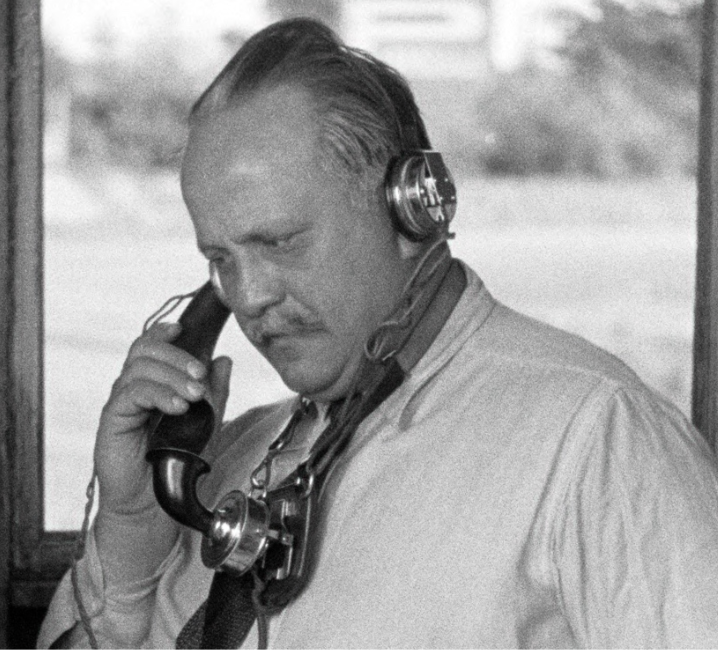
Figure 1
This article focuses on one specific aspect that early sound films shared with the experience of other electronic sound media of the time and that was addressed in scenes of media use: the act of listening. Even though listening had been a component of the silent film experience as well, the media shift to sound encouraged new “techniques” and “practices of listening”6 that were embedded in and informed by the latest electronic sound media and their specific uses. Consequently, scenes of media use in many early sound films were often scenes of listening.7 Taking the opening sequence of The Night Belongs to Us as a case study, this article highlights one such mode of listening in particular, which I call ‘listening to faint sounds and silence’, and suggests that new electronic sound media around 1930, including sound film and radio broadcasting, fostered a new kind of auditory sensitivity in listeners. In this respect, The Night Belongs to Us has to be seen as partaking in the aesthetic discourses on sound film and other sound media of the time, which often stressed the importance of faint sounds and silence.
The “Wonder of the Microphone”
With cinema’s conversion to sound, much intellectual labor went into reconceptualizing film aesthetics, especially in theoretical discourse. How would and should the cinema change? Several writers predicted (and feared) a heavy reliance on spoken dialogue, once again evoking the specter of ‘canned theater’, all too familiar from the debates of twenty years earlier. However, film theory also envisioned alternative paths for the new medium, and some writers assumed that cinema’s transition to sound would create a new awareness of quiet and subtle sounds that usually go unnoticed in everyday life. This discourse was widespread even beyond Germany. In France, Jean Epstein wrote in 1930:
It’s across the sound fields of the vast world that we must spread our microphones, searching the fields with sound-sticks and selective filters. […] To hear everything that a perfect human ear hears is merely apprentice work for the microphone. Now, we want to hear what the ear doesn’t hear, just as through the cinema we see what eludes the eye.8
Writing in Berlin, Béla Balázs too, saw the true potential of sound film in the foregrounding of “utterances overheard” and not in the duplication of the intelligibly speaking or singing voice: “what makes the greatest impression on us is what is closest at hand and quite, quite faint. Not the clear, logical sentence or the formally sung song, in other words, but the fading sigh, the sound of breath, the stifled sob.”9 Making a claim for the medium specificity of sound film, he adds that other media like the theatre were not able to do this:
This is a form of perception that is entirely new. It may be possible to make these sounds in the theatre, but they cannot be framed in close-up and brought into close proximity, unposed, to be experienced with all their original, casual force. What we hear is someone’s private babble, an experience that produces the excitement of a very special form of eavesdropping on another living being.10
Balázs relates sound in film to questions of distance and proximity.11 Both the sound-producing objects and the sound itself can be brought closer to the spectators/listeners than is possible in the theatre, allowing for an experience of intimacy. This is achieved through the “optical” close-up and the “sound” close up, respectively, with the latter term referring to the microphone’s recording of sounds in close proximity. Thus, soft sounds can be made audible to all spectators/listeners:
For the wonder of the microphone is that even amidst the greatest din, it can detect the softest sound simply by moving up close. […] Sound […] is heard by everyone in the auditorium, wherever they sit, from the same distance as that from which the microphone has recorded it. Each of us thus hears the whispering in this sound close-up right against his ear.12
Both Epstein and Balázs emphasize the microphone and its assumed ability to capture minute acoustic signals. At the same time, their emphasis on the “ear” and on “hearing” suggests that the new sound film aesthetics they envision includes the notion of spectators as listeners. Indeed, as I argue, quiet sounds required specific listening techniques. For instance, early sound film audiences needed to listen carefully and attentively, they had to distinguish meaningful sounds from ground noise and anticipate aural cues, and they were invited to admire sound technology’s ability to reproduce faint and sometimes barely audible sounds. Awareness of the potential of faint sounds – and of the new listening practices they required – went far beyond film-theoretical discourses. In fact, as I attempt to show in the following analysis of The Night Belongs to Us, ideas like those put forward by Balázs and Epstein mirrored a broader interest in quiet sounds, which was simultaneously developing among filmmakers and audiences, and which was also evident in the very first sound films produced.
A “Discovery Tour into the World of Noises”
Loosely based on Henry Kistemaekers’ eponymous stage play,13 The Night Belongs to Us was shot in both a German- and a French-language version under the same title.14 The plot offers a blend of domestic and sensational melodrama: after a severe accident during a motor race, driver Bettina Bang (Charlotte Ander) is rescued by a mysterious stranger, who later turns out to be fellow racing driver and bon vivant Harry Bredow (Hans Albers). The two fall in love and become engaged, but Bredow conceals from Bettina that he is still married to his wife Edith (Berthe Ostyn), whom he hasn’t seen in two years. When Bettina accidentally runs into Edith, she is mortified and tries to kill herself during another car race. Bredow manages to save her once again and explains to her that his wife only came to see him to agree to a divorce.
Released in late December 1929, one day before Christmas, The Night Belongs to Us was one of Germany’s very first all-talking features. As such, it was preceded only by the German-language version of Atlantic (E. A. Dupont), a British German co-production shot in London and released in Germany in October, and Ufa’s Melody of the Heart [Melodie des Herzens] (Hanns Schwarz), released just one week earlier in December. All previous German sound films had been either shorts, part-talkies, or synchronized films without dialogue. Also, very few sound films from Hollywood had been screened in Germany up to this point. In this respect, Alan Crosland’s part-talkie The Singing Fool (USA 1928) featuring Al Jolson had been one of the major sound successes on German screens in the summer of 1929. Meanwhile, Jolson’s previous The Jazz Singer, which marked the American breakthrough of sound in 1927, only premiered in Germany in November 1929. By this time, it seemed already quite dated, as it had few actual singing or talking sequences. Against this backdrop, the premiere of The Night Belongs to Us later that year must have been perceived as a major event in Germany’s transition to sound.
At this early stage, however, the aesthetic future of sound film was still uncertain. The few films produced thus far each presented a different approach to the use of sound. Walther Ruttmann’s non-fiction film Melody of the World [Melodie der Welt] contained only music and sound effects but no dialogue, while Atlantic employed dialogue almost non-stop without any non-diegetic music, exemplifying the idea of the “pure talking picture” (reiner Sprechfilm) that had frequently been discussed in the trade press earlier.15 Melody of the Heart, in turn, combined dialogue sequences, songs, and a musical score. The Night Belongs to Us, produced by director Carl Froelich and his own production company Froelich Films, opted for an approach closer to Atlantic, with dialogue remaining central and a musical score used only reluctantly during a few transitional sequences. However, the film’s striking use of noises, as well as its more fluent camerawork and editing, made it appear further removed from the ‘canned theatre’ formula evident in Atlantic. For one critic, it offered a “middle way” between “canned theatre” and “synchronized silent film.”16
The Night Belongs to Us was produced and released at a crucial moment in German film history. Audiences, critics, exhibitors, and shareholders needed to be convinced of the technical and aesthetic capabilities of the Tobis sound film technology in order to bring about the nationwide conversion that the industry was aiming for. Thus, some of the most proficient personnel in the business were involved in the making of the film, among them veteran director Carl Froelich, who had shot some of Oskar Messter’s Tonbilder twenty years earlier, as well as pioneering sound technicians Guido Bagier, known also for his artistic ambitions,17 and Joseph Massolle, one of the inventors of the German Tri-Ergon sound-on-film system. Somewhat conspicuously, a 1929 photograph of Froelich in an advertisement for The Night Belongs to Us, is published at the back end of a specialized monograph on the new technology of synchronized sound,18 The photograph resembles the character of Bang in the director’s own film (as shown in figure 1 above): presumably at work, wearing headphones and listening intensely. The detail of the advertisement (fig. 2) highlights the fact that even the film’s German title might be read as a reference to the act of listening. The German word for “belongs’ is “gehört,” which entails “hört” for “hears” or “listens to.” Clearly, the photograph attests to the changing role of the film director during the transition to sound: previously required to keep an ‘eye’ on what was going on; now they were propelled to ‘listen in.’ Moreover, as the portrait suggest, this act of listening was technologically mediated and afforded specific expertise on the part of the director. The advertisement seems to imply that art, technology, and sensual perception all converge in the person of the director, promoting the eventual success of the new technology.
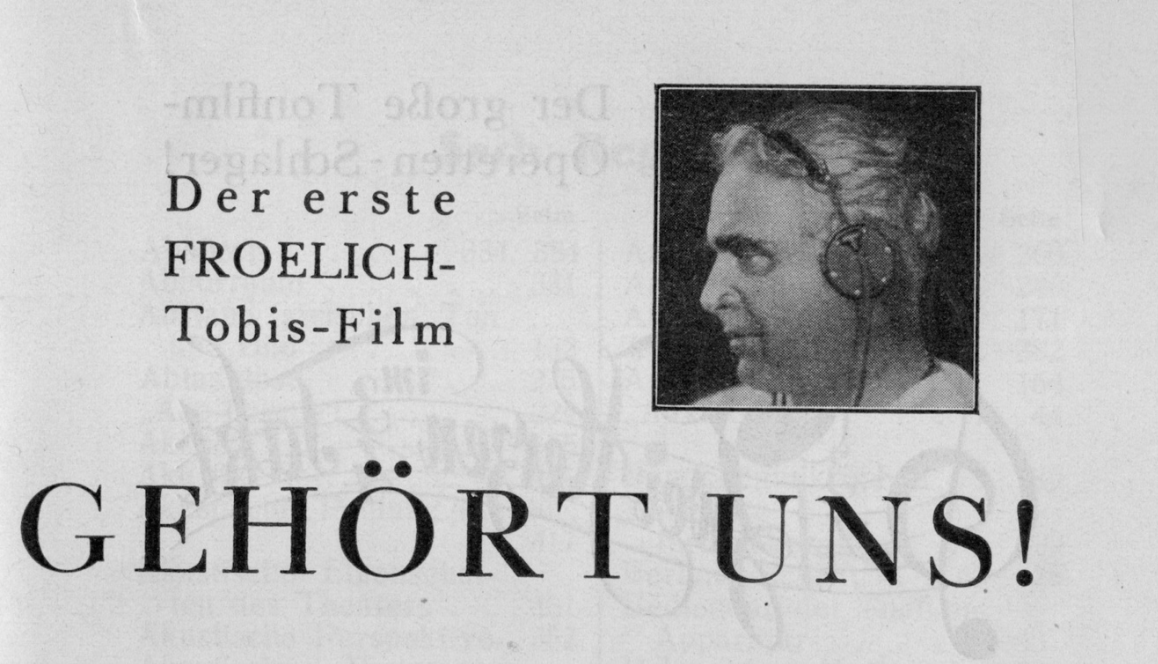
Fig. 2: Detail of an advertisement (with the first part of the film’s title cut off)
Critical reception of The Night Belongs to Us was mostly positive.19 In the trade papers, which were generally advocating the transition to sound, it was even enthusiastic. For Ernst Jäger in Film-Kurier, Germany had finally caught up with Hollywood, and Froelich had created the first pathbreaking German sound film, allowing for “a new experience,” a new “sound film reality.” Praising the film’s overt display of technology through sound (e.g. motor cars, factory machines, telephones, and loudspeakers) and its circumvention of “melodrama” and “soulful schmaltz,” Jäger’s review is an example of how early sound film in Germany was often framed in terms of New Objectivity, celebrating technology and machinery and promising a more ‘objective’ approach to reality. It is no surprise, then, that the author is also much in favor of Froelich’s sparse use of non-diegetic music, writing that “in a serious sound film, the sound source has to be motivated; there must be no lyrical underscoring of landscapes!”20
As much as critics welcomed the film’s reduced scoring, they praised its novel use of noises. One reviewer wrote that The Night Belongs to Us was embarking on a “discovery tour into the world of noises, finding the sounds of the factory, the machines, the racetrack, the ball, of water, and of footsteps, cultivating them systematically, and constructing – for the first time – space as sound,” showing that noises were able to “take on a true poetic function in sound film by giving the poetry of sounding spaces.”21 Film composer Kurt London wrote that with The Night Belongs to Us, “the ‘unchained camera’ is no longer the province of the picture camera. The sound camera has caught on and goes hand in hand with it.”22 Thus, months before the publication of Balázs’s and Epstein’s texts, The Night Belongs to Us already suggested to critics that sound film could be much more than just the reproduction of speech, instead also incorporating the realm of noises.23 This is not to say that the film was perceived as an avantgarde experiment. Rather, the film’s success was considered a breakthrough moment for sound film in general, giving impetus to the full-scale conversion in Germany.
Some reviewers also discussed how the film represents mediated sound at crucial moments that structure the film’s narrative. For example, when Bettina is recovering from her accident, she is seen listening to a record of Caruso on the phonograph because it reminds her of her “mysterious rescuer”; later, there is a scene in which she and Harry talk on the phone. He doesn’t say anything, making her think it’s someone else. This leads to a recognition scene, in which she realizes that it is him who rescued her. Most importantly, it is the film’s opening sequence that is structured around mediated sounds and listening – especially to quiet sounds – as I will explain more fully in a close reading of the scene.
Soft Sounds through the Loudspeaker
In the opening sequence of The Night Belongs to Us, we see the motor race in Palermo during which Bettina Bang’s almost fatal accident occurs. The race is meant to be a test run for a new car engine developed by the German company Diavolo. Only one of the cars, driven by Bettina and labelled “M,” has the new engine in it and is expected to win. The race is monitored by company boss Marten (Walter Janssen) and his team from the headquarters in Berlin, receiving news via telephone from their colleague Bang (Bettina’s father), who is reporting from the racetrack (see fig. 1). Cunningly, the true identity of some of the central characters is not revealed to spectators yet. The car drivers are never shown (or even verbally referred to), so that most historical (and many of today’s) spectators must have assumed “M”’s driver to be a man (and not necessarily the film’s protagonist). Furthermore, it is not revealed yet that the driver is actually Bang’s daughter, nor that she is courted by Marten. These omissions allow the plot to focus on the race itself and on its media transmission, relegating the character relationships to the background.
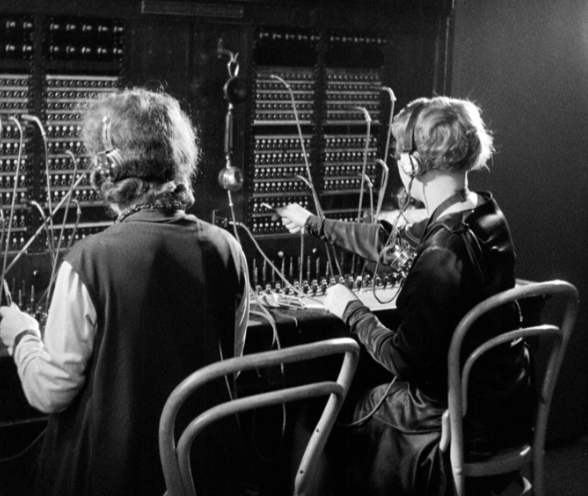
Before the race starts, the sequence takes its time to demonstrate the complex media set-up that is used for communicating between Palermo and Berlin. Marten and Bang are first connected to each other by operators at a central telephone switchboard, creating some confusion and causing Bang to hectically connect and disconnect the wires at this own switchboard. After that, Bang’s telephone voice is “switched over to the loudspeakers” (as it is called by the characters in the sequence) so that his team can listen too. During the race, Bang receives news about the ongoing race from “control stations” (again, a quote from the film) over the phone, passing it on to the headquarters over a second line. Parallel editing links the four different locations: Bang in his booth (with parts of the racetrack visible behind him in rear projection) (fig. 1); the headquarters (fig. 3); the telephone switchboard (fig. 4); and the racetrack itself.
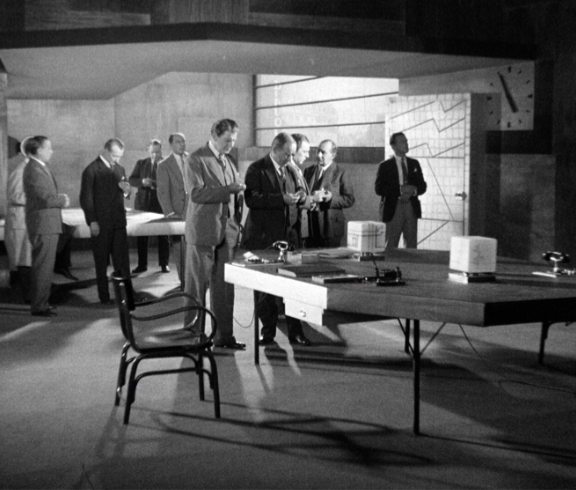
On the auditory level, some of the locations are linked through the characters’ voices, most importantly Bang’s, which connects the Palermo shots with those in Berlin. In doing so, it also changes its tonal quality and ontology: while it sounds relatively natural and is tied to Bang’s body in the booth shots, it is much louder, slightly distorted, and disembodied in the office shots, with the transmitting loudspeakers being visible in the background (in the restored version of the film). In the context of Weimar cinema, this is one of the earliest examples of what Michel Chion would later call “acousmatic” or, more specifically, “on-the-air sound”: an off-screen sound, supposedly transmitted by electronic media, that traverses spatial boundaries and filmic spaces. In addition, the authoritative quality of the voice emanating from the loudspeakers almost anticipates Chion’s concept of the acousmêtre, an intangible voice that derives power from being unseen. This concept was realized more fully in films such as Fritz Lang’s Das Testament des Dr. Mabuse (1932).24
The difference between the two kinds of voices becomes especially pronounced when the change from one shot to another (and accordingly from one tonal quality to another) happens in the middle of a sentence.25 These conspicuous and sometimes abrupt changes from the ‘original’ voice to the one coming from the loudspeaker display the effects that multi-level media transmission (telephone, wires, switchboard, loudspeakers) can have on the human voice, such as the split between body and voice and the voice’s modulation or even defamiliarization.26 But even within the booth shots, the voice often changes its modality when Bang (presumably) disconnects and talks to himself rather than to his colleagues. When not used for official reporting anymore, his voice becomes much quieter and more intimate, his language more colloquial (as I will explain in more detail below). The sequence thus presents a wide range of different modalities of the human voice and exemplifies the role of electronic media in creating them. In fact, while one might consider Bang’s voice in the booth natural and unmediated, viewers of early sound films were probably acutely aware of the mediated nature of all sound coming from the theatrical loudspeakers, whether or not they were presented as such within the films’ diegesis.
Scenes of Listening
Throughout the sequence, the activity of listening is also highlighted visually. Bang’s two different headphones, clearly visible in most shots, and those of the telephone operators, constantly remind viewers that the characters engage with each other largely by listening to each other. In the office shots, the employees’ body postures signal the act of listening, too. As the sequence continues, moments in which Bang falls silent (because there is no new information) occur more often, and we see the employees statically waiting for his voice coming through the loudspeakers. This waiting becomes especially tense when “M” is expected to arrive at the control station after the so-called “hell’s bend” (Höllenkurve) but has gotten out of sight. The characters turn silent, waiting and listening to the silence coming from the loudspeakers. The only thing to be heard at this point is the ground noise on the film’s soundtrack, which mimics the kind of sound one would expect the characters to hear from the loudspeakers in the office (an interesting case of the film’s ground noise becoming almost diegetic).
The emphasis on listening in the film’s diegesis also draws attention to the spectators’ own listening activities. Often, silence and soft sounds signal to the audience that they should be quiet and listen. Right at the beginning of the sequence, as the film’s opening score fades out, there is a visual fade-in to a medium close-up of Marten alone in his office as he puts a cigarette into his mouth, then a cut to a long shot of the office, in which he blows out the smoke and walks away from the camera into the room. While the first shot is completely silent, the second one is accompanied by the soft sounds of Marten exhaling and his faint footsteps.27 It is as if the spectators were trained right from the beginning to be quiet and listen carefully in order to catch all the faint sounds that the film has to offer. Later on, the attentive listening to the on-the-air silence by the team in the office mirrors the (potentially) silent behavior of the film’s audience. However, the object of listening is not always exactly the same. Initially, both spectators and characters are waiting for Bang’s voice to deliver the next message and are forced to listen to the white noise, but then, the spectators become more privileged in that they get to hear the more intimate sounds that Bang produces instead. For instance, there is a direct cut from the silently listening staff in the office to Bang in his booth opening a water bottle, the sounds of which can be heard in great detail (fig. 3 and 5).
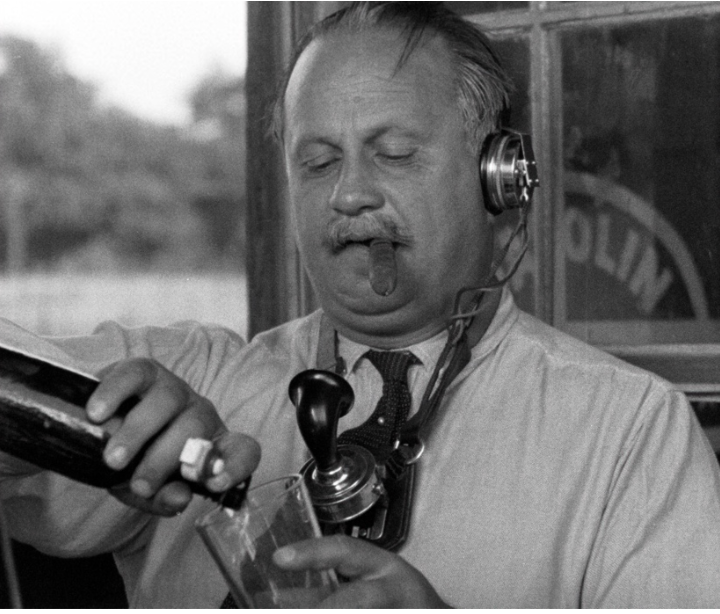
Fig. 5
As the sequence continues, spectators are increasingly encouraged to listen to the soft sounds produced by Bang in the booth while waiting. In several shots, he is seen in (medium) close-up, talking and mumbling to himself and performing mundane activities, such as attempting to light a cigar or filling a glass of water. The sounds that accompany these activities (for instance, the clicking of the bottle cap and the pouring of water into the glass) are almost like showcases for sound film technology’s capacity to reproduce soft sounds faithfully – gestures of emphatic presentation, underlined by the positioning of the sound-producing objects in the visual foreground. In fact, Carl Froelich was highly aware of this: during the making of the film, he claimed that “the Tobis equipment is even more successful in the recording of quiet and intimate talking sequences.”28
Next to noises coming from objects, we hear soft sounds from Bang himself, such as heavy breathing, sighing, chuckling, and mumbling to himself. These seem to have been striking moments for contemporary viewers, especially because of their expressive quality. For instance, Ernst Jäger remarked that “the characters come closer to us than in the old pantomime, with their mumbling, their little sighs.”29 In fact, mumbling was actor Otto Wallburg’s trademark even as a theatre actor (Jäger’s German word “Geblubber” directly referred to his nickname “Blubberer”, which in Berlin slang means someone who speaks unclearly) and it seems likely that it was deliberately put to use in this early sound film.30 Many of his – probably improvised – utterances in this sequence are barely intelligible. For instance, when he fails to light a match for his cigar, he says something close to “Herrgott noch mal” (“for Christ’s sake”).
Towards the end of the sequence, when it becomes apparent that the car had an accident and we see (and hear) the characters’ somber reactions, Bang’s utterances turn into even fainter breathing, sobbing, and mumbling (just as the camera moves even closer to his face). Most notably, the words “Mein Kind” (“my child”), hinting at the car driver’s identity (Bang’s daughter) for the first time, might have been difficult to understand for contemporary audiences, depending on the sound equipment and the viewing/listening conditions during specific screenings, which raises the question whether or not the filmmakers wanted everybody in the audience to understand these words and learn about the driver’s identity at this point.31 In any case, revealing the protagonist’s identity through a line of dialogue that might have gone unnoticed by some spectators/listeners seems to be deliberate playfulness on the part of the filmmakers, an experiment of how far the use of soft sounds could be pushed. This reading seems even more likely as the utterance is repeated in the next shot, which shows the employees sitting speechlessly with their heads bowed down. Here the line “my child” can be heard again, this time presumably transmitted over the loudspeakers and almost completely drowned out by ground noise.32
The “my child” utterance illustrates a general tension that is also evident in Weimar cinema’s trade paper discourse. On one hand, the ability of the sound apparatus to capture quiet sounds and voices was frequently highlighted and often said to account for sound film’s potential for aural realism, especially in contrast to the theatre. On the other hand, at least some of these statements seem to be more wishful thinking than accurate descriptions of what was heard in movie theatres. For instance, critics as well as actresses and actors often complained that lines of dialogue were not always fully intelligible during screenings.33 While this contradiction can be partly explained by the fact that technical conditions varied from theatre to theatre and also evolved over time, even single articles sometimes contained both arguments. In a review of Ariane (Paul Czinner, D 1931), the author complains that he could not understand all of Elisabeth Berger’s lines of dialogue even after repeated viewing. Nonetheless, he was fascinated by the “appealingly intimate nuances” of her voice.34 It is more likely, then, that impressions of intimacy and nuance in actors’ and actresses’ voices were not necessarily linked to intelligibility. In the case of Bang, the faint sounds coming from him, especially the sobbing and heavy breathing, facilitate access to his emotions (in tandem with the optical close-up) regardless of whether or not each word can be perfectly understood. In fact, the sequence shows that, while intelligibility was generally regarded as a guideline for technicians, filmmakers and audiences in the early period of sound films, there was a parallel fascination, nowadays often overlooked, for other forms of speech in which intelligibility was not the primary goal.35
The Low Signal in Late 1920s Audio Culture
The historical reception of early sound films as a “discovery tour into the world of noises” and as a “school of listening” needs to be understood within the intermedial context of 1920s audio culture. Listening to faint sounds and silence was a mode of listening already existent in other media like radio broadcasting, for instance. In the opening sequence of The Night Belongs to Us, the link to radio is made more or less explicit by a range of references. Bang in his phone booth, apparently not receiving any feedback from the headquarters, strongly recalls the figure of the lonely radio host speaking to a distant audience, which was discussed at the time by writers like Arnold Zweig, Alfred Döblin, and Rudolf Arnheim.36 Simultaneously, it evokes the established motif of the individual radio listener wearing headphones (usually male) in the German visual arts.37 Furthemore, the setting of the sequence must have reminded spectators of the new radio format of live reports that had become popular in previous years. Journalist Alfred Braun had supposedly invented the format by accident in 1927, when he was waiting for the arrival of transatlantic aviator Clarence Chamberlin at the recently opened Berlin Tempelhof Airport.38 Live reports on sports events like races subsequently became popular with listeners, allowing them to “experience the tension of the moment,”39 as one critic described the format’s distinguishing mark. Maybe most explicitly, Bang’s repeated exclamation “Achtung! Achtung!”, already known from Germany’s first public radio broadcast in 1923, had quickly become the famous trademark of Braun’s live reports. Moreover, it seems likely that radio broadcasting was a point of reference for filmmakers in this sequence, because in the original stage play, news about the female protagonist winning a car race is received over a radio news show rather than over the phone: the voice of the radio was to appear as coming from a loudspeaker on stage (designated as “Le Haut-Parleur” in the text).
Finally, the sequence’s conspicuous use of faint sounds resonates with contemporary discourses on the aesthetics of the radio in Weimar audio culture. The “discovery” of soft sounds and voices, discussed by writers like Balázs and Epstein in relation to sound film, was also an issue in debates on the radio, which for some – especially in the case of the radio play (Hörspiel) – was supposed to become a “symphony of noises,”40 a “way back – or forward – […] from the abstraction of words to the reality of sound, to acoustic richness.”41 Already in 1925, Rolf Gunold noted that through the radio, listeners could learn how to become more sensitive to sounds, thus anticipating Balázs’s and Epstein’s ideas about the revelatory potential of sound film:
The listener is most important, we need to teach him how to use an organ that has been weakened so much due to the supremacy of the optic nerves: the ear. The acoustic radio play needs a disciplined audience. And this discipline consists of careful and undisturbed listening. Noises and ambience that man has not yet paid attention to become the center and starting point of dramatization. Perhaps, the radio will thereby fulfil a cultural task at the same time, teaching man how to listen well again.42
For some commentators, the voice in particular was to be the central component of radio broadcasting. For instance, as if in response to Balázs’s idea of man becoming “visible” in silent film, writer Anton Kuh claimed that the purpose of the radio was “the discovery of the human voice”.43 The proper radio voice was supposed to be much more subdued and intimate than other, earlier forms of public address. For Arnheim, “the normal tone of transmission, for example, has to be that of a light, intimate conversation between broadcaster and listener.” Here, he saw a potential for the expression of emotions: “the quiet voice trembling with inner emotion, the suppressed outburst, the note of real feeling that needs no blustering to make one aware of it.”44 Other writers, like Balázs, saw a potential in the radio drama in particular to display “the intimate atmosphere of a quiet scene in a room.”45 Yet others claimed that “the purpose of radio broadcasting is to give back to the ear the most tender ability to perceive the timbre, breath, and reverberation of the spoken word.”46
Again, Alfred Braun typified this approach with his so-called “whispering reports” (Flüsterreportagen), in which he secretly reported from behind a shield, most famously during the Nobel Prize ceremony in 1929, when Thomas Mann received the award. If Braun did not exactly whisper in these reports, he did speak with a markedly softer voice. Furthermore, he would sometimes pause for lengthy stretches of time, waiting for events to unfold until something new occurred that he could comment on, as can be heard, for instance, in a recorded live report on politician Gustav Stresemann’s funeral (also 1929).47 Most strikingly, when the coffin arrives in front of the dead minister’s former workplace and is placed there for a minute’s silence, Braun falls silent too, creating a 20-second stretch of pure ground noise. Just like the company board in The Night Belongs to Us (and the film’s spectators), Braun’s radio listeners were forced to listen to the silence, waiting for the next piece of information.
Conclusion
The Night Belongs to Us is a film firmly embedded in Weimar audio culture. It presents other devices of listening such as telephones and loudspeakers and alludes to specific radio formats such as live reports, while simultaneously demonstrating the capacity of the new medium of sound film to reproduce faint sounds. It turns spectators into conscious listeners who mirror the fictional listeners on-screen, demonstrating that – together with other new electronic sound media – sound film fostered new practices of listening, such as paying attention to soft sounds, listening to silence while awaiting sound, seemingly moving closer to the sound source, and differentiating between low signals and overwhelming ground noise. As the example thus shows, early sound films in Germany related to the intermedial constellation around 1930 in various ways: through direct display of other sound media in scenes of media use, through allusions to contemporary aesthetic discourses, and by self-reflexively addressing spectators as listeners. The aesthetic future of sound film was negotiated from within this constellation.
Daniel Wiegand is Professor of Film Studies at University of Zurich with a research focus on early film history, including the transition to sound. He is author of Das schweigende Bild: Ästhetik der Stille im frühen Tonfilm (Schüren, 2026, forthcoming) and Gebannte Bewegung: Tableaux vivants und früher Film in der Kultur der Moderne (Schüren, 2016), as well as editor of Aesthetics of Early Sound Film: Media Change Around 1930 (Amsterdam UP, 2023). Among his other recent publications is ‘Islands of Sound in the Silent Flow of Film:’ German Part-Talkies Around 1930 as a Hybrid Medium,” in Historical Journal of Film, Radio and Television (2022).
Footnotes
1 An earlier version of this article was published in Retuning the Screen: Sound Methods and the Aural Dimension of Film and Media History (Proceedings of the XXVII International Film and Media Studies Conference), ed. Maria Ida Bernabei, Simone Dotto and Paolo Villa (Milano/Udine: Mimesis International, 2022), p. 85–94. I am grateful to the editors for allowing the publication of this revised version. A more extended version in German appears as a chapter in: Daniel Wiegand, Das schweigende Bild. Ästhetik der Stille im frühen Tonfilm (Marburg: Schüren, 2026).
2 See Daniel Wiegand, “The Aesthetics of Early Sound Film: An Introduction”. In: Aesthetics of Early Sound Film: Media Change around 1930, ed. Daniel Wiegand (Amsterdam: Amsterdam University Press 2023), pp. 8–9.
3 Frank Kessler, “Photogénie und Physiognomie”. In: Geschichten der Physiognomik, ed. Rüdiger Campe and Manfred Schneider (Freiburg: Rombach, 1996), p. 125.
4 The following analysis of the film is based on a new digital restoration by Deutsches Filminstitut (see https://www.filmportal.de/film/die-nacht-gehoert-uns\_813a0f4ecc724b999330c138f6805ea5).
5 This article is indebted to a wide range of studies on early sound film’s intermediality, in particular to Donald Crafton’s notion of “electric affinities” in his The Talkies: American Cinema’s Transition to Sound, 1926–1931, (Berkeley et al.: University of California Press, 1999) pp. 23–61, and to the approach proposed in Loin des yeux… le cinéma. De la téléphonie à internet: imaginaires médiatiques des telecommunication et de la surveillance, ed. Alain Boillat and Laurent Guido (Lausanne: L’Age d’Homme, 2019); see especially Martin Barnier, “Allo? Allo? Qui parle? Les premiers sons téléphoniques au cinéma” (pp. 245–260), for a discussion of telephone scenes in early sound film.
6 Jonathan Stearne, The Audible Past: Cultural Origins of Sound Reproduction (Durham: Duke University Press, 2003).
7 Thomas Elsaesser speaks of the “mise-en-scène of the act of listening.” See Thomas Elsaesser, “Going ‘Live’: Body and Voice in some Early German Sound Films”, in: Le son en perspective. Nouvelles recherches / New Perspectives in Sound Studies, ed. Dominique Nasta and Didier Huvelle (Brussels: Peter Lang, 2004) pp. 155–168.
8 Jean Epstein, “The Cinema Continues”, in French Film Theory and Criticism, ed. Richard Abel (Princeton: Princeton University Press, 1988), p. 67.
9 Béla Balázs, Early Film Theory: Visible Man and The Spirit of Film, (New York: Berghahn, 2011), p. 195.
10 Ibid.
11 See Izabella Füzi, “Connecting and Disconnecting: Sound and Cinema in Balázs’s Film Aesthetics”, in: Et al. – Critical Theory Online, 2015,. http://etal.hu/en/archive/terrorism-and-aesthetics-2015/fuzi-connecting-and-disconnecting/
12 Ibid., p. 96.
13 Henry Kistemaeckers, La nuit est à nous…: pièce en trois actes et quatre tableaux, (Paris: La petite illustration, 1925).
14 I was not able to consult the French version, La nuit est à nous (Carl Froelich/Henry Roussell, F 1930), for this article.
15 See e.g., for a negative perspective, R. Herbertz, «Nicht Sprechfilm, aber Klangfilm», in: Film-Kurier, 15 March 1929.
16 “Kritiken der Woche”, Der Film, 28 December 1929. All translations of German sources are mine unless indicated otherwise.
17 Bagier had previously shot several part-talkies and experimental sound shorts such as Aus der Welt der Geräusche [From the World of Noises] (Tobis 1929).
18 Der Tonfilm. Grundlagen und Praxis seiner Aufnahme, Bearbeitung und Vorführung, ed. Heinz Umbehr and Hans Wollenberg (Berlin: Verlag der Lichtbildbühne, 1930), p. 472.
19 For a more detailed analysis of reviews, see Daniel Wiegand «‹Eine Entdeckungsfahrt in die Welt der Geräusche›. Zur historischen Rezeption des frühen Tonfilms Die Nacht gehört uns (D 1929)», in: Montage AV 2, 2021, pp. 59–75.
20 Film-Kurier, 24 December 1929. “Serious sound film”, in this context, is a term used in opposition to film genres like the musical or the comedy. However, Jäger, in his enthusiasm, failed to mention that Froelich did use a score in some scenes. A reviewer for the music section in Deutsche Filmzeitung was more accurate here, pointing to what he/she perceived as a contradiction between the film’s “objective” character and its sentimental score (“Musik-Umschau”, Deutsche Filmzeitung, 10 January 1930, p. 8). According to an earlier report, Froelich had still been indecisive about whether or not he should use a score during the shooting of the film (Ur [Michael Urak]: “Kleine Streife durchs Aufnahmegelände: Auf der Avus wird ein Tonfilm gedreht”, Film-Kurier, 29 August 1929).
21 “Kritische Filmschau”, Deutsche Filmzeitung, 10 January 1930, p. 5.
22 “Kritiken der Woche”, Der Film, 28 December 1929.
23 Even though there is no evidence for this, it seems likely that both Balázs and Epstein were inspired by the soundscapes of The Night Belongs to Us given the popularity of both versions of the film. Balázs mentions the film in The Spirit of Film, albeit in a different context, when he speaks of the use of different languages in one film (here German and Italian), calling it a “linguistic landscape” (Béla Balázs, Early Film Theory, cit., p. 195).
24 See Michel Chion, Audio-Vision: Sound on Screen (New York: Columbia University Press, 1994), pp. 76–78, 129–131. In the writings of the 1920s and 1930s, the phenomenon of offscreen sound was mostly discussed in terms of “asynchronous sound” or “asynchronism”, which was seen as a decidedly artistic and creative device, as opposed to the naturalistic attraction of “synchronous sound” (see e.g. Rudolf Arnheim, Film as Art, London: Faber & Faber, pp. 260–270.
25 For example, Bang is shown in his booth saying, “Well, let’s hope everything will go fine, we all reckon …”, and in the following shot, the sentence is continued by the “loudspeaker voice” saying: “… for car ‘M’”.
26 Interestingly, the filmmakers reinforced this difference: instead of simply using Bang’s voice from the booth and altering its sound quality, they used a different recording, in which Wallburg spoke louder and clearer.
27 See also Daniel Wiegand, “The Aesthetics of Early Sound Film: An Introduction”. In: Aesthetics of Early Sound Film: Media Change around 1930, ed. Daniel Wiegand (Amsterdam: Amsterdam University Press 2023), pp. 8–9. The exhaling sound is so close that it was probably not produced by Janssen himself but either post-synchronized (which was technically possible even at this early stage) or recorded on site by someone standing closer to the microphone.
28 Ur [Michael Urak]: “Kleine Streife durchs Aufnahmegelände: Auf der Avus wird ein Tonfilm gedreht”, cit.
29 Film-Kurier, 24 December 1929.
30 There is a later, self-reflexive scene, in which Bettina Bang says to her father: “You always talk so fast and unclearly”, when he is practicing for a speech.
31 During digital restoration, the volume was adjusted in only a few (other) places in the film. The restored version therefore authentically reproduces the original volume levels on the optical sound negative at this point. I would like to thank restorer Louise Burkart for pointing this out to me. See also her article on the restoration of Die Nacht gehört uns: “Filling the Gaps in an Incomplete Film: Some Thoughts and Questions on Film Reconstruction”, in Journal of Film Preservation 107, 10, 2022, pp. 93–10.
32 The line is repeated more clearly in a later scene, when Bang has reached the site of the accident and kneels down beside the wrecked car.
33 See Olga Tschechowa, “Der Kampf um die Nuance”, Reichsfilmblatt, 10 May1930; Hans Steinmetz, “Kamera und Ton: Gesamtkunstwerk Film V”, Deutsche Filmzeitung, 4 April 1930, pp. 4–5; “Kritische Filmschau: Der blaue Engel”, Deutsche Filmzeitung, 9 May 1930, pp. 9–10.
34 Deutsche Filmzeitung, 13 March 1931, p. 8. In general, Ariane seems to have been perceived as a film with striking uses of quiet sounds. As another reviewer noted: “We hear rustling, whispering, breathing” (“Schlußbilanz der Großen Woche”, Lichtbild-Bühne, 21 February 1931).
35 For the related concept of the “voice-out”, see Justin Horton, “The Unheard Voice in the Sound Film”. In: Cinema Journal, 52:4, 2013, pp. 3–24.
36 “Even if the whole world may hear the words that I speak into the microphone, I am alone with the microphone” (Arnold Zweig, “Über Tiefenwirkung im Rundfunk” [1929], in Radio-Kultur in der Weimarer Republik, ed. Irmela Schneider (Tübingen: Gunter Narr, 1984), p. 93. Alfred Döblin noted the “dreadful silence on the other side of the microphone” (“Auszug aus einem Interview zur Frage nach dem Verhältnis zum Rundfunkpublikum”, in Radio-Kultur, cit., pp. 98–100. Arnheim described the “loneliness of the studio where you sit alone with your voice and a scrap of paper and yet before the largest audience that a speaker has ever addressed” and argued that the monologue “fulfils the primary function of broadcasting, which is that of a voice speaking to an audience” (Rudolf Arnheim, Radio, Faber&Faber, London 1936, pp. 20, 177).
37 E.g. The Radionist (Kurt Günther, 1927) or Man with Radio (Homo Sapiens) (Kurt Weinhold, 1929). A slightly later example is The Radio Listener (Max Radler 1930).
38 Interview, 18 October 1952, quoted from “Wie Alfred Braun die Rundfunkreportage erfand”, https://www.swr.de/swr2/wissen/archivradio/wie-alfred-braun-die-rundfunkreportage-erfand-100.html (last accessed February 11, 2026). For more on Braun and the representation of German broadcasting in early German sound film, see Jörg Schweinitz, “Reporters, Radio Waves, and the Dispersed Audience: Staging the Radio in Early German Sound Cinema”, in: Aesthetics of Early Sound Film: Media Change around 1930, ed. Daniel Wiegand (Amsterdam: Amsterdam University Press, 2023), pp. 157–174.
39 Hermann Kasack: “Mikroreportage”, in Radio-Kultur, cit., p. 129.
40 Hans S. von Heister, “Um ein Hörspiel. Randbemerkungen zum Preisausschreiben der Reichs-Rundfunk-Gesellschaft” [1927], quoted from Radio-Kultur, p. 17.
41 Rudolf Leonhard, “Technik und Kunstform”, in, Radio-Kultur, cit., p. 70.
42 Rolf Gunold, “Wege zum akustischen Drama” [1925], in: Radio-, cit., p. 171–173, 172.
43 Béla Balázs, Early Film Theory: Visible Man and The Spirit of Film, cit., p.10; Anton Kuh, “Angst vor dem Radio” [1930], in Radio-Kultur, cit., p. 54.
44 Rudolf Arnheim, Radio, cit., 71, 81–82.
45 Béla Balázs, “Das Radiodrama” [unpublished manuscript from the 1920s], quoted from Béla Balázs, Ein Baedecker der Seele und andere Feuilletons aus den Jahren 1920–1926, ed. Hanno Loewy (Berlin: Das Arsenal, 2002), pp. 19–20.
46 F. Walter Bischoff: “Die Ästhetik des Rundfunks”, in Radio-Kultur, cit., pp. 73–74.
47 The recording can be accessed here: https://www.swr.de/swr2/wissen/archivradio/aelteste-radioreportage-trauerzug-fuer-gustav-stresemann-100.html (last accessed February 6, 2026).