GENUINE: The Tragedy of a Strange House
Fern-Andra film by Decla-Bioskop, 1920
Director: Robert Wiene
Screenplay: Carl Mayer
Camera: Willy Hameister
Sets and Costumes: César Klein
Cast: Fern Andra (Genuine), Ernst Gronau (Lord Melo), Hans Heinz von Twardowsky (Florian), John Gottowt (Guyard, the barber), Harald Paulsen (Percy), Albert Bennefeld (Curzon), Lewis Brody (Malaye)
Reconstruction and editing: Stefan Drößler
Digitization: Thomas Bakels
Editing and color grading: Christian Ketels
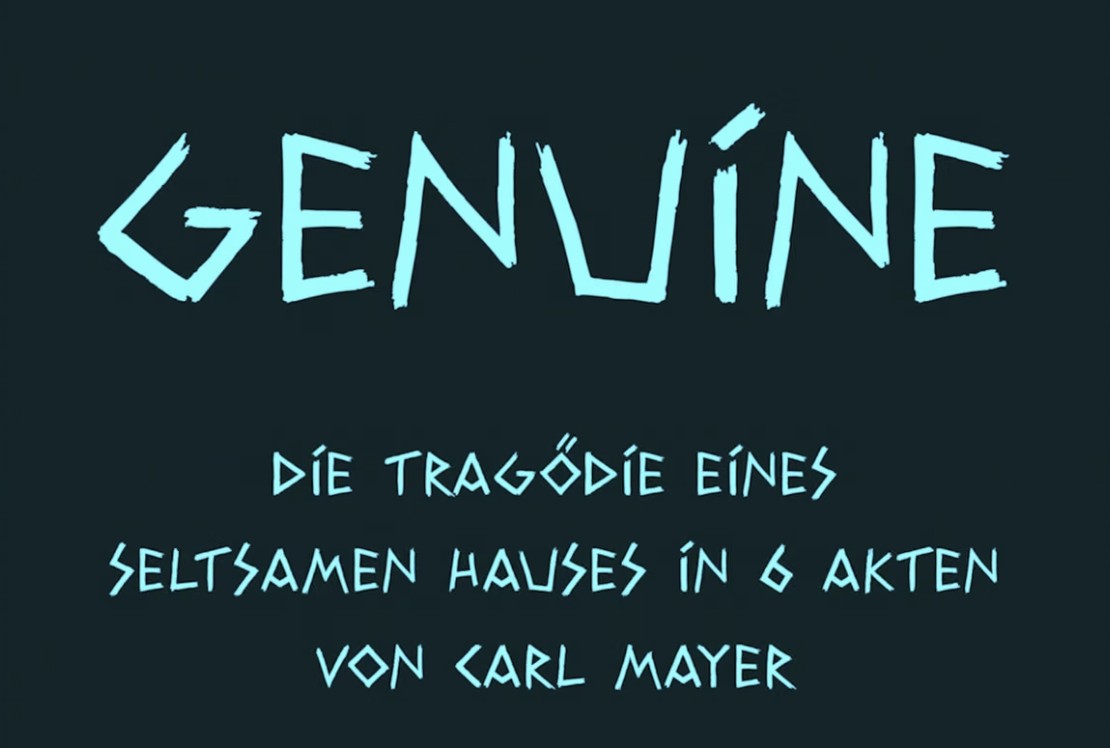
Title design: Heiner Gassen
Production: Filmmuseum München, 2026
Support: Sunrise Foundation for Education and the Arts
Trailer for GENUINE (4:46 Min.)
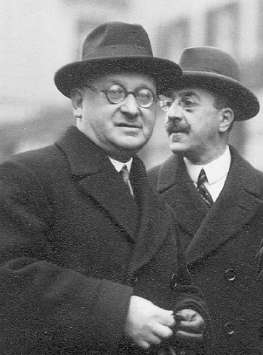
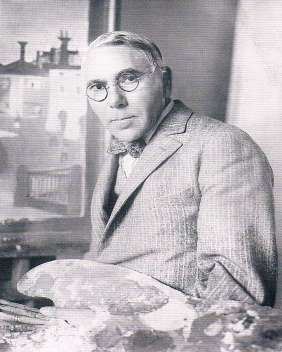
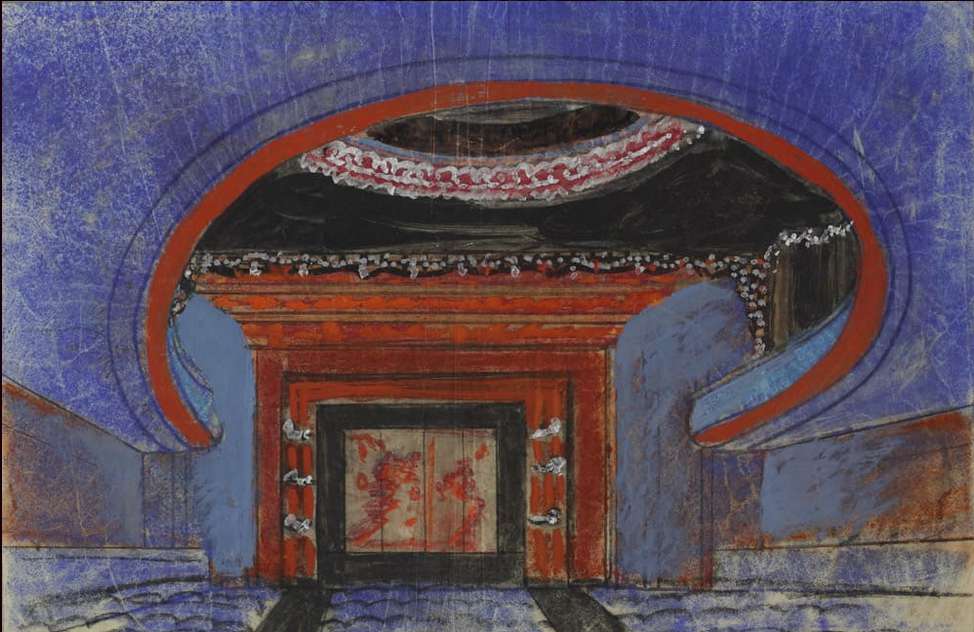
When GENUINE had its premiere in Berlin on 2 September 1920, the Berliner Börsen-Courier wrote: “No expense has been spared; costumes and sets were clearly costly. The film contains a good number of handsome images. For the purpose, they even brought in César Klein, an Expressionist painter of publicly recognized standing. In Fern Andra they engaged an extraordinarily pretty and even mimically expressive actress, who over six reels gets to wear, by rough count, thirty-six bizarre costumes: prima donna that she is, she plays the role — voluptuous, cruel, tender — always aware that the whole enterprise exists only to show how good Fern Andra looks. And perhaps that is really all the film is for.”1 Fern Andra (1893–1974) rose to stardom in the 1910s and is largely forgotten today because almost none of her films survive. It is notable that Andra, who had performed as an acrobat in variety shows from a young age, was in her melodramas and circus dramas not only the leading lady but also acted as screenwriter, director, and producer.2 GENUINE is her first film for a major production company under the direction of an established director: Robert Wiene (1873–1938), who had scored a spectacular worldwide success with THE CABINET OF DR. CALIGARI. In GENUINE, Wiene wanted “to resolutely renounce the depiction of reality and to find new tasks in the realm of the unreal — of spirituality, of the expression of feeling.” He demanded: “The fairy-tale forest and the magic palace, and all the settings through which the imagination of an E.T.A. Hoffmann moves, will be built for the film’s dramatist by the Expressionist, so that they may whisper mysteriously of the artistic intimation of things that are not of this world.”3 For this purpose, the painter, stage and costume designer César Klein (1876–1954) was engaged, who had become known for his stylized paintings and stage designs for theatrical productions, and who had decorated the foyer and interior of Berlin’s Marmorhaus cinema, opened in 1913, where both CALIGARI and GENUINE had their premieres. Accordingly, the reviewer for Film-Kurier remarked: “It is as though the Marmorhaus had been built for just such fantastical occasions. Stylistic unity between the venue and what was on offer was maintained.”4
Robert Wiene
César Klein
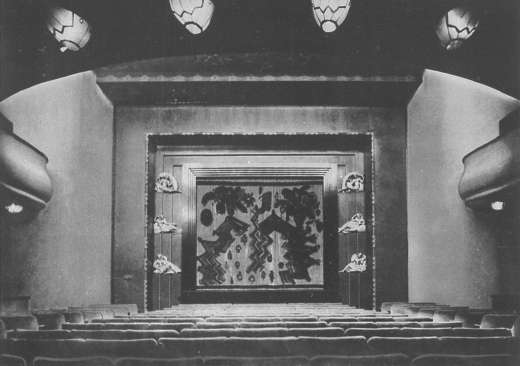
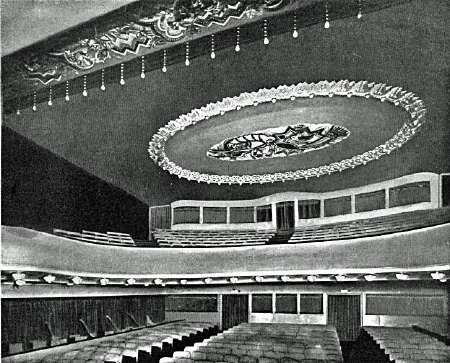
The Marmorhaus in Berlin: stage and ceiling painting designed by César Klein
The screenplay by Carl Mayer (1894–1944), unfortunately no longer extant, blends elements of contemporary pulp fiction5 into the bizarre story of a mysterious house, surrounded by high walls, in a small Irish town, whose reclusive owner keeps a seductive vampire captive in an exotic grotto beneath the cellar.6
The film GENUINE divided critics: for some it is “a colorful, garish, fantastically magical potpourri of grotesque ideas. But new! And always engaging. Always captivating.”7 They praised the attempt “to rescue film from the sphere of the everyday,”8 spoke of “a serious striving toward artistic perfection without regard for a popular taste that is, unfortunately, so often kitschy,”9 and called Wiene “a painterly genius” and “the first poet to give film a style.”10 Das Tage-Buch wrote of GENUINE: “From the very first scene the film is unreal and fantastic, and precisely because of that, compelling. We have seen quite enough racing cars, leaps from rooftops, and two thousand extras running through the cinema. The artistic film — that will be the non-naturalistic one! Mayer’s screenplay meets this demand, and above all it is fulfilled by César Klein’s suggestive imagery, to which the actors submit.”11 Others rejected the film outright: “It is quite out of the question that an average audience could understand, or even come to terms with, such starkly executed Expressionism. The simple man from the people, confronted with something like this, is bound to become alienated from his old favorite, the cinema, and that is why I reject this direction. Not because I am hostile to Expressionism as such, but because it will not do to create films that only a small handful of the elect can truly understand and appreciate.”12
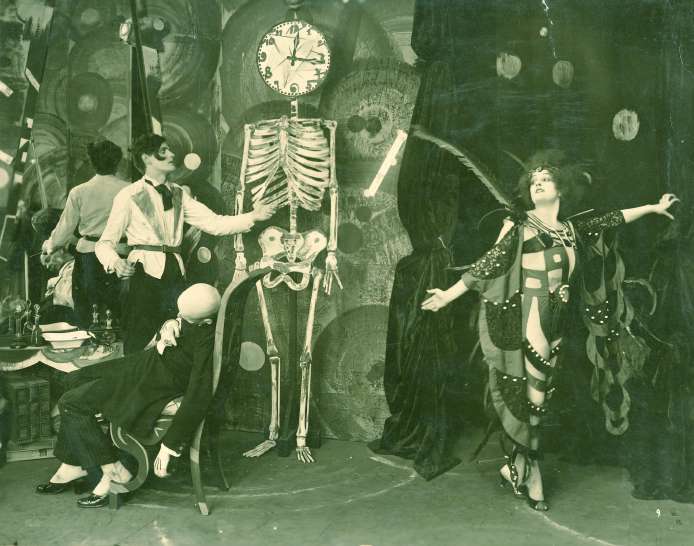
Tinted still from GENUINE
At the premiere, “strong applause and lively opposition”13 collided. In the days that followed, there were reports of booing and whistling, as well as demands for refunds of admission money.14 Fritz Olimsky wrote: “At the Marmorhaus, tempers now clash quite fiercely every evening — some hiss, others applaud — all in a dispute over the worth or worthlessness of a work that is, in my eyes, nothing more than an interesting poisonous plant.”15 Although the Marmorhaus announced in its newspaper advertisements that the film was “sold out daily”16 and would be “held over for another week,”17 it was taken off the program on 10 September 1920 after only eight days. Outside Berlin, GENUINE fared better and was shown in cinemas in every major and minor German city until autumn 1921. An advertising campaign hailed the film as the “artistic event of the season.” In Dresden, after a week at the Olympia-Theater on the Altmarkt, the run of GENUINE was “extended by a week due to overwhelming demand,” with evening screenings “regularly selling out.”.18
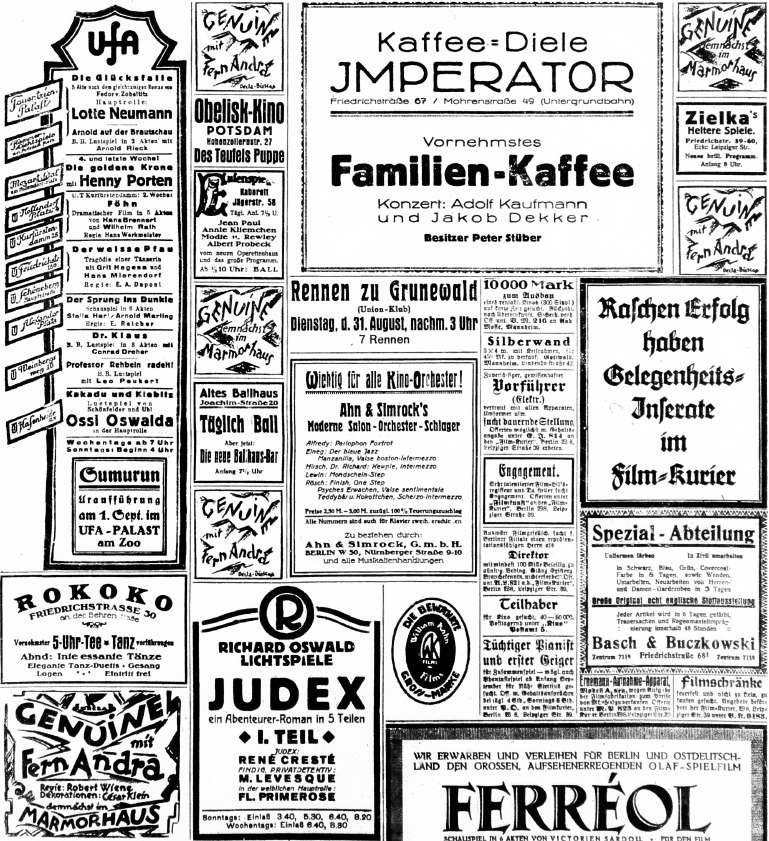
Advertising campaign in the Film-Kurier, 30 August 1922
In Munich, GENUINE opened on 1 October 1920 simultaneously at two cinemas, the Kammerlichtspiele and the Lichtschauspielhaus, ran a second week at the Viktoria-Theater, and was shown once again for four days at the Bavaria-Lichtspiele toward the end of 1920.
Sales abroad were few. In Finland the film could be seen for two weeks at the Eldorado cinema in Helsinki starting 12 December 192119, and for a single day at the Alhambra cinema in Turku on 2 March 1922.20 On 9 August 1922 the film opened at the Cine Palais in Rio de Janeiro21, but was withdrawn after four days. In Japan, GENUINE had its premiere on 20 October 1922 at the Teikokukan cinema in Tokyo22 and was regarded as a work of Expressionist art.23 In Austria, by contrast, the police censors banned the film because, “apart from several scenes offending against public decency, it appears, in its content and dramatic structure, so senseless and devoid of any logical and reasonable development that it would likely arouse the liveliest indignation among audiences and might possibly provoke demonstrations.”24 When GENUINE was sold to France in 1922, the trade paper Der Film reported that Robert Wiene would have to “undertake a thorough reworking of the film and make sweeping changes in order to make the picture acceptable for France, and above all for the French censors.”25 At the Paris press screening on 25 May 1922 at the Ciné-Opéra — where GENUINE was released in the official program on 21 July26 — a new THE CABINET OF DR. CALIGARI was expected.27 The screening was correspondingly well attended, and dissenting voices were drowned out by applause.28 Wiene had reworked the film completely29; the French version is more than a quarter shorter than the German censorship length. An added frame story identified Percy, the nephew of the owner of the uncanny house, as a dreaming painter, thereby actually aligning the narrative structure with that of THE CABINET OF DR. CALIGARI.
French critics viewed the film largely favorably: “It’s a film one ought to have seen, for it gives a very accurate impression of the modernist tendencies in German film production. It’s a work of art that one may love or disapprove of, but it is a work of art.”30 Claude Fayard praised Fern Andra: “She brings to mind those great venomous flowers that are beautiful only the better to lure to their death those to whom they offer it: with her frizzy hair, her flared nostrils, her feline gestures, her sharp teeth, Fern Andra is the ideal interpreter of this strange girl. Baudelaire would have loved her.”31 Marcel Achard remarked: “Robert Wiene knows marvelously how to evoke, in his images, Albrecht Dürer and Heinrich Heine in his reveries. I am surprised he has not yet thought of filming the tales of Hoffmann.”32 But there were also dissenting voices, who dismissed the film as “silly”33 and found Fern Andra’s performance ridiculous: “The artist, Fern Andra, can only move her arms in a snaky way and show her claws without succeeding in being graceful. She is just as artificial as the whole production, and does not give the idea of a real woman being led away by sheer passion.”34
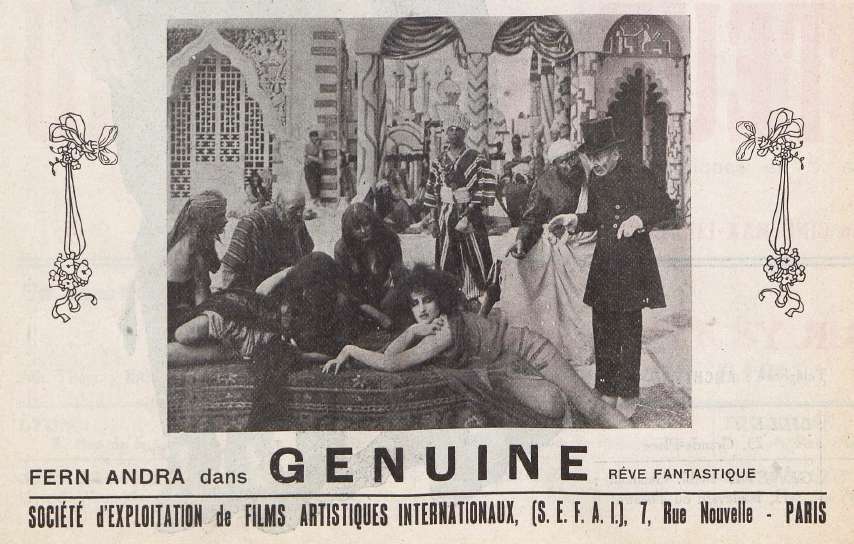
Courrier cinématographique, No. 38, 23 September 1922, p. 30
Two prints of the shortened French version, differing in their state of completeness — one from the Cinémathèque de Toulouse, the other from the Cinémathèque Suisse — are the only surviving film material of GENUINE. In 1996 they formed the basis of a first reconstruction of the film by the Filmmuseum München, in which the frame story and structure of the French adaptation were retained. Unfortunately, Carl Mayer’s original screenplay, which might have shed light on scene rearrangements and cuts, has not survived. Since all the scenes mentioned in contemporary reviews are extant, it appears to be chiefly transitional scenes and embellishments that are missing. For the new digital reconstruction of GENUINE, inconsistencies and differences in the tinting of the two prints were reconciled, and a new color scheme was developed with regard to setting, mood, and narrative logic. In addition, stills were inserted to make abbreviated scenes more comprehensible.
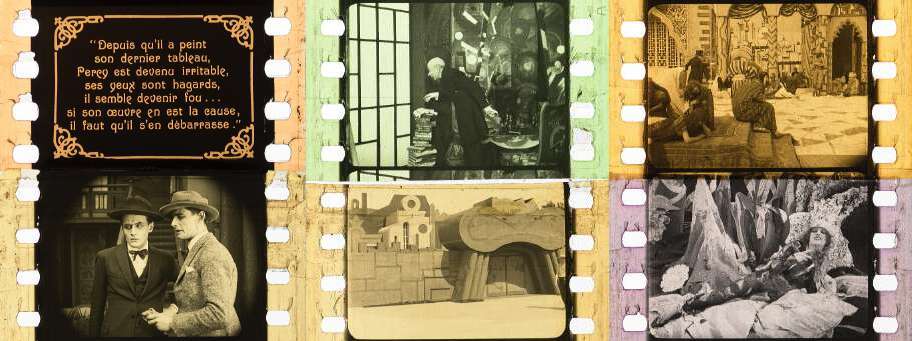
Nitrate print from the Cinémathèque de Toulouse (www.filmcolors.org)
The German intertitles, in their “reeling letters”35 and “bizarrely distorted, blurred writing,”36 survive in neither their original form nor their exact wording. Back-translations from the French and phrasings drawn from contemporary German synopses were used instead. The typeface chosen takes its cue from the lettering used in the contemporaneous film FROM MORN TO MIDNIGHT.
The poor state of preservation of GENUINE may be one reason why most film historians have never questioned, but simply adopted, Rudolf Kurtz’s damning verdict in his 1926 book Expressionismus und Film: “GENUINE is a film of pure décor, whose unorganized jumble pains the eye more than it pleases it. The figures remain without contour, the plot lost in fog. All guidance has been lost. GENUINE stands on no ground whatsoever: neither in the reality of the day nor in that of art.”37 Only more recently have there been attempts at a reassessment. In their monograph Robert Wiene, der Caligari-Regisseur, Uli Jung and Walter Schatzberg firmly reject “the assessment of GENUINE as a failed attempt to repeat CALIGARI’s commercial success through a superficial copying of its style”: “What the two films have in common is not merely their painted sets, but also their interest in the psychological dimensions of their plots. What distinguishes GENUINE from CALIGARI, however, is a fairy-tale-like, at times even mythological, treatment of the fantastic.”38 For Mirjam Kappes, GENUINE is “a valuable subject for research since it touches on dramatic social changes in postwar Weimar society, especially the erosion of traditional male and female roles. By undermining the male character as a weak, powerless and disoriented figure who is helpless in the face of a wicked woman’s alluring sexuality, the film presents to us a distinctive narrative scenario in which the danger does not primarily come from a male rival but from an empowered, dangerous woman who pulls all the strings.”39
An undated newspaper clipping from the Berliner Montagspost, held in the collection of the Deutsches Filminstitut in Frankfurt am Main, offers a glimpse into the tumultuous reception of GENUINE in 1920:
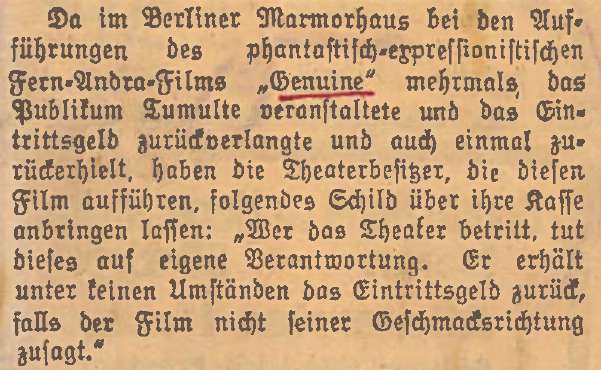
“Since, at screenings of the fantastic-Expressionist Fern-Andra film ‘Genuine’ at Berlin’s Marmorhaus, audiences repeatedly staged uproars and demanded their admission money back — and on one occasion actually got it back — the theater owners showing this film had the following notice put up over their box office: ‘Anyone entering the theater does so at their own risk. Under no circumstances will admission money be refunded should the film not suit the visitor’s taste.’”
Footnotes
1 tz: “Genuine”; in: Berliner Börsen-Courier, No. 415, 5 September 1920, p. 4.
2 “Fern Andra, the Mason’s Daughter”; in: Sächsische Dorfzeitung, No. 114, 18/19 May 1929, p. 9.
3 Robert Wiene: “Expressionism in Film”; in: Berliner Börsen-Courier, No. 353, 30 July 1922.
4 L. K. Frederik: “Genuine”; in: Film-Kurier, No. 196, 3 September 1920, p. 1.
5 The reviewer for Das Tage-Buch writes: “I have read the novella by Carl Mayer from which the film was made. It speaks well of the film that the printed novella made no impression at all. It was written for the cameraman, not the reader; for the reader it would have to be completely rewritten from the ground up. Some of the literary echoes that survived into the film do it no favors either, for instance the blood-sucking business. That sort of thing one may perhaps read (in H. H. Ewers), but one certainly does not want to see it — it irritates rather than grips.” (“Naturalistic or Fantastic Film?”; in: Das Tage-Buch, issue 37, 25 September 1920, p. 1220.)
6 Illustrierter Film-Kurier, No. 25.
7 Georg Popper: “Waterloo-Theater: Genuine”; Hamburger Theater-Zeitung, No. 37, 17 September 1920, p. 17.
8 ct: “‘Genuine’ at the Marmorhaus”; in: Vossische Zeitung, No. 437, 4 September 1920, p. 6.
9 E.K.: “Genuine”; in: 8 Uhr-Abendblatt, 3 September 1920, quoted in: Film und Presse, No. 9, 11 September 1920, p. 221.
10 Balthasar: “SUMURUN and GENUINE”; in: Freie Deutsche Bühne, issue 3, 12 September 1920, pp. 59–60.
11 “Naturalistic or Fantastic Film?”; in: Das Tage-Buch, issue 37, 25 September 1920, p. 1220.
12 Fritz Olimsky: “Genuine”; in: Berliner Börsenzeitung, No. 397, 5 August 1920, p. 8.
13 E.K.: “Genuine”; in: 8 Uhr-Abendblatt, 3 September 1920, quoted in: Film und Presse, No. 9, 11 September 1920, p. 221.
14 “Against Expressionist Film”; in: Leipziger Tageblatt, No. 424, 11 September 1920, p. 2 / undated newspaper clipping from Berliner Montagspost, in the collection of Deutsches Filminstitut, Frankfurt am Main.
15 Fritz Olimsky: “Genuine”; in: Berliner Börsenzeitung, 5 September 1920, p. 8.
16 Advertisement for the “Marmorhaus” cinema in: Deutsche Allgemeine Zeitung, No. 434, 5 September 1920, p. 8.
17 Advertisement for the “Marmorhaus” cinema in: Berliner Tageblatt, No. 424, 9 September 1920, p. 9.
18 “Miscellaneous”; in: Sächsische Staatszeitung, No. 213, 15 September 1920, p. 2.
19 Advertisements in: Filmrevyn, No. 8, 1 December 1921, p. 37 / Svenska Tidningen, No. 294, 19 December 1921, p. 2.
20 Advertisement in: Åbo Underrättelser, No. 59, 2 March 1922, p. 1.
21 Advertisements in: O Journal, No. 1093, 9 August 1922, p. 9 / O Journal, No. 1097, 13 August 1922, p. 11.
22 Advertisement in: Tokyo Asahi Shimbun, 19 October 1922, p. 2.
23 Shinnosuke Kudo: “The Expressionist Film”; Zentraler Kunstverlag, Tokyo, 1923, pp. 83–97.
24 “Results of the Police Censorship”; in: Der Filmbote, No. 42, 16 October 1920, p. 41.
25 “Genuine redivivus”; in: Der Film, No. 19, 7 May 1922, p. 53.
26 “Programmes des Cinémas de Paris”; in: Cinéa, No. 63–64, 21 July 1922, p. 3.
27 R.J.: “Will There Be a New ‘Caligari’?”; in: Le Petit Journal, No. 21.674, 20 May 1922, p. 4.
28 A. René Sti.: “Les Présentations”; in: Le Journal du Peuple, No. 145, 26 May 1922, p. 2.
29 “Import–Export”; in: La Courrier cinématographique, No. 19, 13 May 1922, p. 45.
30 V.G.D.: “Genuine”; in: Ciné-Journal, No. 667, 27 May 1922, p. 27.
31 Claude Fayard: “A Hallucinatory Film: Genuine”; Paris-Guide, No. 25, 3 June 1922, p. 10.
32 Marcel Achard: “Au Fil des Films”; in: Le Peuple, No. 522, 11 June 1922, p. 2.
33 P.: “Genuine”; in: L’Action française, No. 300, 27 October 1922, p. 2: “There is, in particular, a greenhouse with wooden flowers resembling cabbages, and a leafless tree striped like a zebra, which are the height of comedy. Genuine walks about in a thoroughly successful costume: a great plume on her head, a very sheer trailing coat, and a lace-frilled bathing suit. It’s pretty, pretty… It’s idiotic.”
34 “The Trade in France”; in: The Film Renter & Moving Picture News, No. 469, 4 November 1922, p. 15.
35 “Genuine”; in: B.Z. am Mittag, 3 September 1920.
36 L. K. Frederik: “Genuine”; in: Film-Kurier, No. 196, 3 September 1920, p. 1.
37 Rudolf Kurtz: Expressionismus und Film; Verlag der Lichtbildbühne, Berlin, 1926, p. 73.
38 Uli Jung and Walter Schatzberg: Robert Wiene, der Caligari-Regisseur; Henschel Verlag, Berlin, 1995, p. 87.
39 Mirjam Kappes: “Expressionist Film and Gender: Genuine, a Tale of a Vampire (1920)”; in: Olaf Brill and Gary D. Rhodes (eds.): Expressionism in the Cinema; Edinburgh University Press, Edinburgh, 2016, p. 77.
About the Author
Stefan Drössler, film historian, lecturer and curator, has been Director of Bonn International Silent Film Festival (1985-2020), Bonner Kinemathek (1986-1999), and Filmmuseum Muenchen (since 1999). He reconstructed and restored more than 150 films and edited more than 100 DVDs in the Edition Filmmuseum (www.edition-filmmuseum.com).