Reflecting on Anders als die Andern Today
If the future imagined by Weimar filmmakers for 2026 came true, we would inhabit Metropolis (1927).1 Skyways and skyscrapers, a Moloch machine, seductive robots, class division reminiscent of H.G. Wells’ 1895 dystopian classic novel The Time Machine…we certainly are there in spirit. Metropolis’s futuristic fantasy is, of course, also social commentary – what would the world look like in a hundred years if things remained fundamentally unchanged? In this respect, for all its cinematic brilliance and pervasive artistic influence, Metropolis is not very ambitious.
Thinking about the future, planning for it, imagining oneself in it, and trying to change it are human nature and fodder for the cinematic dream factory. Cinema is a powerful tool with which to re-imagine the world. If, as Karl Marx famously wrote, “[m]en make their own history, but they do not make it as they please; they do not make it under self-selected circumstances, but under circumstances existing already, given and transmitted from the past,” what if, in a cinematic dreamworld, the issue of pre-existing circumstances was moot? Could people – first the actors onscreen, and then the audience in the real world – have a chance at making their own history?
Anders als die Andern (1919) offers nothing like the visual splendor of Metropolis, but its fantasy of the future was and remains far more ambitious. This ambition lies not in the film itself, but in what film can do. If Metropolis intensified the German 1920s reality to its logical conclusions, Anders als die Andern simply shows reality as it is, there is drama, conflict, and tragedy enough. Anders als die Andern’s future, not depicted in onscreen but articulated in the last scene, posits human rights and dignity as the final frontier. And this was a frontier its audiences had to reach outside of the cinema.
In 2026, which is not Metropolis but also is, how does Anders als die Andern hold up? Maybe it too is ambivalent. On the surface Anders als die Andern might present itself as a near-unwatchable silent film fragment, advancing its argument through science now considered not only outdated but problematic. Yet no other film highlights the gap between 1920s potentials and 2020s realities quite like Anders als die Andern. No other film makes the past so present, and makes the present feel so much like its injustices should have long since been consigned to history.
Part I: What is Anders als die Andern and why is it special?
A brief recap: Anders als die Andern is an Aufklärungsfilm, a sex education film, made during the November Revolution and it was specifically intended to turn popular sentiment against Paragraph 175, a law that prohibited sex between men. It includes a near-extradiegetic lecture by sexologist Magnus Hirschfeld that broadens the film’s antidiscrimination scope to include all “sexual intermediaries,” that is, every variation of sexuality, sex, gender identity, and gender presentation. All, Hirschfeld intones, are natural and normal – science has proved this beyond the shadow of a doubt, and in our rational, modern world, we listen to science.
The film premiered uncensored in May 1919 and was popular enough to run for five weeks. It caused a scandal, the effects of which were to bring back film censorship, which had been abolished along with all forms of federal censorship immediately following the armistice that ended World War I. Although on October 16th, 1920, Anders als die Andern became the first film the new federal censor office banned, Hirschfeld kept copies to screen at his Institut für Sexualwissenschaften. When Nazi students sacked the Institut in May 1933, they destroyed all copies of the film. The only surviving clip of footage representing a third of the 1919 version comes from another of Hirschfeld’s educational films, Gesetze der Liebe (1928), which had been exported to Czechoslovakia in 1928 and contained a truncated version of Anders als die Andern. This footage with Ukrainian intertitles appeared in an Austrian Richard Oswald retrospective in 1971, sourced from the Soviet film archive Gosfilmofond.2 Since its re-emergence, the footage has been reconstructed multiple times to approximate Anders als die Andern’s 1919 release.
Most Aufklärungsfilme at the time had a specific formula. Their plots would feature characters exemplifying desirable and undesirable behavior as well as the consequences of each, hoping to steer its audiences towards the good.3 Here Anders als die Andern is already different from the others. It does not instruct its audiences to avoid abusing alcohol and to get their syphilis chancres examined by a certified doctor by putting the horrors of alcoholism and tertiary syphilis onscreen. The horror is instead societal, it lives within the audience itself. Viewers are not supposed to change their behavior to protect themselves, but to protect marginalized individuals.
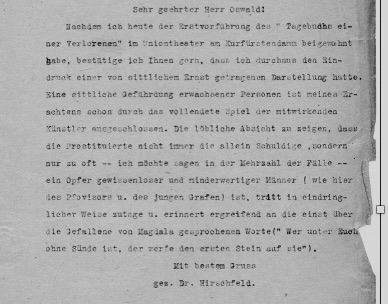
Anders als die Andern has one very specific aim: compassion. Here it rests upon two assumptions. Firstly, at this point in history in the spring of 1919, when Germany itself was in the process of becoming a democracy, compassion might be able to change people who could change politics and thereby change society. Secondly, film and particularly narrative film was still new, it had unknown but presumably significant effects on the human psyche, and its powers might be harnessed for good. “Good” in this case meaning to foster empathy and fellow-feeling in viewers. This aspect comes through in a police-intercepted letter from May 1918 (half a year before the war ended) from Magnus Hirschfeld to Anders als die Andern’s director, Richard Oswald.
Landesarchiv Berlin, A / Pr / Br / Rep. 030-05 / Nr. 1643 / Bl.65.
Having seen the premiere of Oswald’s Das Tagebuch einer Verlorenen (1918), Hirschfeld was moved to contact the director and praise his sympathetic depiction of a sex worker. The text of the letter reads:
“Very honored Mr. Oswald:
After I attended the premiere of “Diary of a Lost Girl” today at the Uniontheater on Kurfürstendamm I gladly confirm to you that I thoroughly had the impression of a depiction imbued with moral seriousness. A moral threat to adults is, in my opinion, already impossible due to the consummate acting of the contributing artists. The praiseworthy intention to show that prostitutes are not always solely at fault, instead only too often - - I’d like to say in the majority of cases - - a victim of unscrupulous and shoddy men (as in this case the apothecary and the young count), manifests itself in a powerful way and reminds poignantly on the words once said about the fallen woman of Magdalene (“He that is without sin among you, let him first cast a stone at her”).
With best greetings,
signed Dr. Hirschfeld” 4
There is no evidence of a response from Oswald.
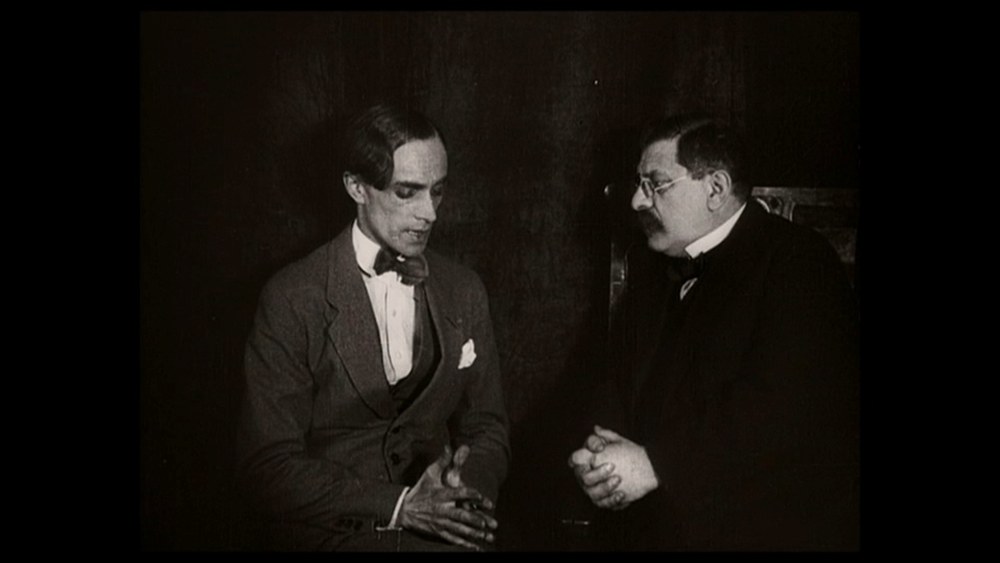
Oswald and Hirschfeld’s first collaboration was a two-parter on sex workers, Die Prostitution (1919). Anders als die Andern however made use of Hirschfeld’s own presence and thereby assumes a hybrid form. The film is both melodrama and real, the sexologist performing a diegetic and extradiegetic role. Hirschfeld would have been known to German audiences.5 His real-life public lectures approximated what is shown in Anders als die Andern and the film was one part of a larger effort he made in the summer of 1919 to reach the widest possible audience. A month after Anders als die Andern’s premiere, Hirschfeld opened his Institut für Sexualwissenschaften. On his film cameo, Hirschfeld said: “I ask that you interpret this contribution not as if I’m taking on the role of an actor. The actor’s great endeavor is to embody other figures that differ from himself. There can be no question of that with me.”6
Conrad Veidt (l) and Magnus Hirschfeld (r) in Anders als die Andern
In light of Hirschfeld’s statement on his acting, the above scene in which the sexologist counsels the protagonist, explaining that there is nothing wrong with being homosexual, showcases Anders als die Andern’s melodrama-documentary hybridity. Conrad Veidt, the film star playing the protagonist Paul Körner, is acting; Hirschfeld as the sexologist is not. Twenty-first century viewers watching the scene, as well as Hirschfeld’s later presentation, are given the unique (and strange) opportunity to be lectured at by a person born in 1868 telling them that homophobia is wrong. Through the film’s hybridity, we assume the same role as German moviegoers in 1919.
This time travel, this role conflation, is common to all silent films, but Anders als die Andern still strikes a special chord. It was the main attraction at a starry 1999 Munich AIDS benefit gala. “It is fascinating how the medium of film eighty years later conveys a human’s presence,” one viewer said, “[f]ascinating like a fax machine […] [h]ow material disintegrates and then comes back together, that makes me happy.”7 The fax machine analogy also seems to account for Anders als die Andern’s destruction and fragmented state, the film standing in as a proxy for the violence sexual minorities experienced through the intervening years and continuing to the present. Does Anders als die Andern’s specific message, its intervention in a social justice issue that remains unsolved, make its human presence that much more relatable?
Part II: Why this film (still) matters
Anders als die Andern is dated – as it should be. It is, after all, more than one hundred years old. It is dated as science, as a film, but as activism? In its original sense, yes, certainly. Paragraph 175 was struck from the German Criminal Code in 1994. But perhaps the old film’s activism now is different than what was intended in 1919. Anders als die Andern’s outdatedness might actually be part of its appeal; it could be one key reason why this film matters today. The outdated means through which the film makes its still-relevant argument now seem disconnected from the actual argument. This very disconnection carries potential.
During the height of the AIDS crisis in 1986, film scholar and gay rights activist Vito Russo gave impassioned commentary to Anders als die Andern when it was broadcast on American television for the first time. The film, per Russo, “survives as an accident of history,” and he ties it into its own history, noting that it was protested by proto-Nazis, but also opens it up. Russo directs the viewer to observe the exterior shots of pre-World War II Berlin, the first representation of a gay bar, emphasizing the film’s time-capsule-like qualities. He ends his commentary with Hirschfeld’s exile, the Nazis in power, decades of doomed gay characters in cinema, and the continued presence of Paragraph 175. But there is no mistaking Anders als die Andern’s tragic timelessness. “It pleaded something radical,” Russo emphasizes, “tolerance for what was then called the ‘third sex.’” “Tolerance” is a word he returns to, a plangent underlining both of the request’s modesty (live and let live), but also the deadly consequences, then and now, of intolerance.
Russo handily makes Anders als die Andern into a document of the AIDS crisis, that is, he gives the film another story to tell. “Twice-told tales” is how film scholar Vivian Sobchack describes a documentary about a 1920s film set depicting ancient Egyptian ruins and now a ruin of itself rediscovered decades later in the Californian desert sands.8 Over its century of existence, Anders als die Andern has become at least twice-told. The tales it now carries in addition to its original one come across in the film’s two reconstructions in the 2010s. The first, undertaken by UCLA for Outfest in 2013, re-imagines Anders als die Andern as a 1910s-1920s Hollywood movie; it smooths out the incomplete footage’s lacunae to create a watchable, if rather short and spare film. Frustrating as that might be for silent film scholars, aficionados, and historians, it is worth mentioning that such people might not be this reconstruction’s target audience. Outfest’s Anders als die Andern provides a genealogy, it seeks not to teach, but rather to show that LGBTQ+ people have always existed.
The Outfest Kickstarter campaign’s call to “save this film,” however, feels a bit disingenuous if one remembers that Anders als die Andern had already been restored into something approximating its 1919 release by Stefan Drössler of the Filmmuseum München in 2004. Nevertheless, that is the spirit in which the American press received it.
As odd as it may be to see Anders als die Andern smoothed into the pseudo-Hollywood film it never was with all indicators of its own history and context brushed away, the argument is clear. The film is relevant because it serves as representation and for that, it just has to exist. Film scholar Ervin Malakaj puts a powerful intellectual spin on this concept in his own arguments as to why Anders als die Andern is important and why it still matters today in his 2023 book of the same name. Feeling along with Anders als die Andern’s suffering protagonist, for present-day queer audiences, creates linkages across time and space. Malakaj argues that Anders als die Andern facilitates “feeling backward,” it makes space for mourning and affirms the negativity that still structures the world so many queer people move through.9
The same scholars, aficionados, and historians should find satisfaction in Drössler’s most recent 2019 restoration; the DVDS include a selection of archival documents pertaining to Anders als die Andern. The DVD set includes Gesetze der Liebe (1927) and Geschlecht in Fesseln (1928), putting Anders als die Andern in dialogue with other queer German silent films.10 This Anders als die Andern enters into a ready-made discursive forcefield of films and documents; it foregrounds historical context. The film serves here as an access point to the Weimar Republic, and specifically its sexual politics. As such, Anders als die Andern is an invaluable resource. Drössler’s restoration is smooth enough to be watchable as a film, but the scars are left visible; the restoration leaves no doubt that Anders als die Andern tells multiple stories. Rather than serving as a touchstone like the Outfest version, this Anders als die Andern invites viewers into the revolutionary moment and into Weimar sexual politics.
Twice-told stories also raises the question of which stories to tell, and which stories have historically been told at the expense of others. Watching Anders als die Andern today forces us to think critically about whom we lionize, whom we accept as authority figures, and perhaps most crucially, whether we need these figures in the first place. In keeping with the Aufklärungsfilm genre as it existed in wartime and interwar Germany, Anders als die Andern makes use of a scientific-medical authority figure who clearly explains to the audience what is right and wrong, just in case viewers could not be trusted to come to the correct conclusion on their own. In this case, the authority is Hirschfeld, who for decades devoted himself to playing this role in real life as well.
Hirschfeld is no longer (if he ever was) an appropriate authority figure and perhaps at this point we should be able to dispense with our need for heroes.11 Regarding Cesar Chavez, icon of the farm workers’ movement recently proven to have assaulted numerous women and minors, podcaster and food writer Soleil Ho argues “[i]n a more collectively oriented society, charismatic egotists wouldn’t be so load-bearing that threatening them would be an existential catastrophe. They would just be parts of a greater whole.”12 While Hirschfeld has not quite risen to the level of a #MeToo candidate, his imbrication and involvement in his racist, sexist, eugenicist, colonialist milieu has been extensively documented by historians Heike Bauer and Laurie Marhoefer.13 Even earlier, a 2006 taz article on a new edition of the sexologist’s 1933 book Weltreise eines Sexualforschers highlights the problematic nature of Hirschfeld’s research.14 Paraphrased from the article, with his foot firmly planted on some decommissioned cannons in Indonesia that had been repurposed as phallic symbols, Hirschfeld’s very posture conforms to arrogant European superiority tropes.
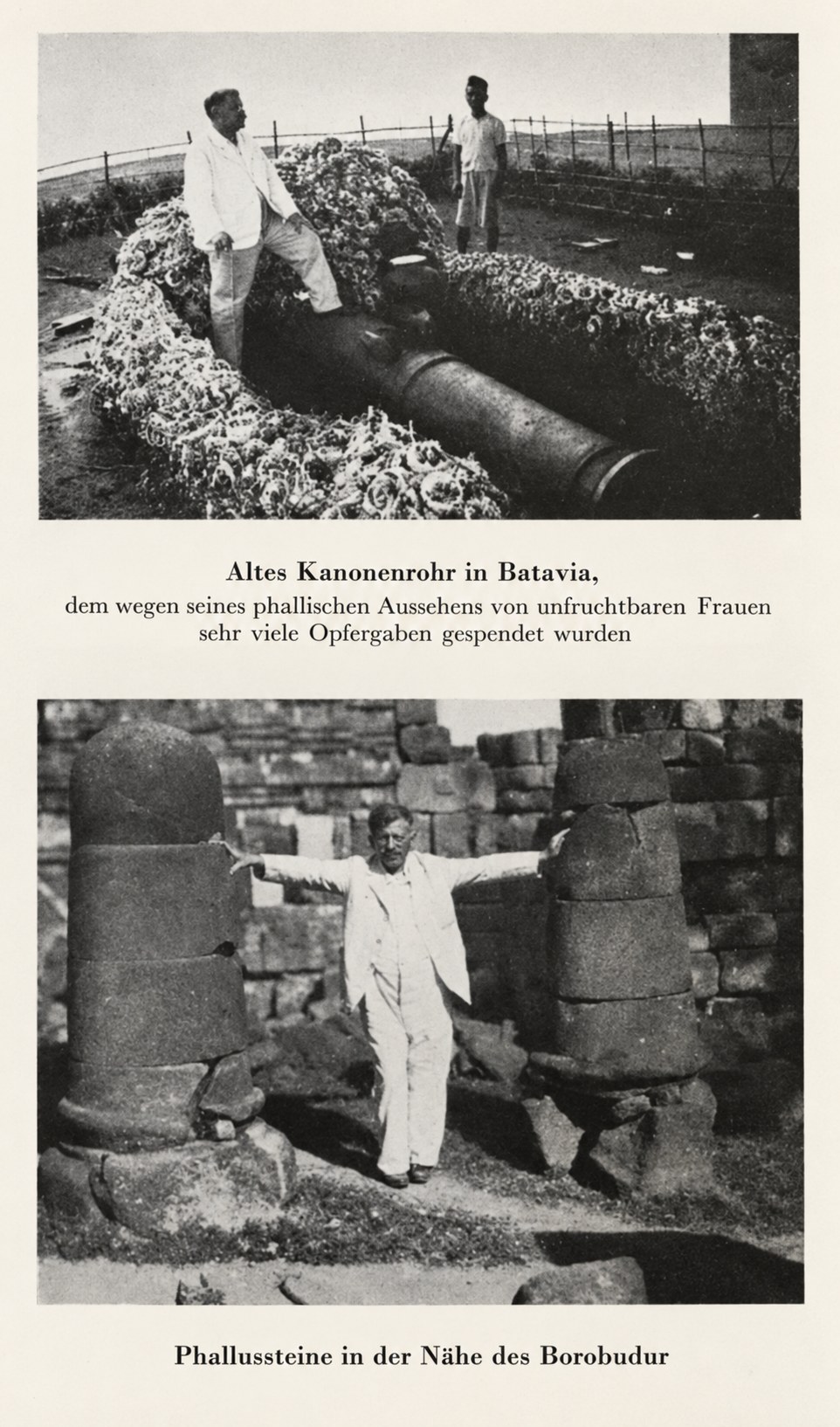
Image insert in Hirschfeld’s 1933 book Die Weltreise eines Sexualforschers of Indonesian phallic artifacts.
Whatever we think of Hirschfeld the person, scientist, and activist, his authoritative-authoritarian stature in Anders als die Andern could and should invite consideration of him as a load-bearing structure. Such a figure may have been necessary in 1919, but might it be possible to operate our movements in a more collective fashion today? An Anders als die Andern made in 2026 might, per Ho, re-imagine the sexologist as just one part of a greater whole. It might give its protagonist more agency and more options. It might have more faith in its viewers, and trust them to get the message on their own without needing an authority figure to spell it out.
In Anders als die Andern’s multiple retellings, what stays the same? I was struck, when doing research for my dissertation project on Anders als die Andern’s context, reception, and legacy, how similar audience reactions to the film were over the past century. Two sources a century apart, Hirschfeld’s Jahrbuch für sexuelle Zwischenstufen in 1919 and a pinboard displayed at the Berlin Schwules Museum 2019 exhibition on Anders als die Andern, show common themes. Viewers emphasized the film’s emotional impact, its resonance for the queer community, and the effect of seeing Hirschfeld onscreen. For instance, an editor in 1919 wrote, “[t]he film was an experience for me. It will be an experience for many hundreds of thousands, no, for millions. Everyone who sees it must understand how unhappy we are because the world ostracizes us. You will accomplish a lot through this film. You have done a good deed.”15 Kristina Jaspers, curator at the Deutsche Kinemathek, remarked in a similar vein on the pinboard. “A film,” she wrote, “can hardly accomplish more: promote empathy, give role models, and show that one is not alone.”16 A postal worker in 1919 commented, “[w]hen the scene came where you, worthy Herr Doktor, gave a lecture, I was very interested in your remarks on homosexuals. Most of all, I was interested in your own personality.”17 Filmmaker Rosa von Praunheim’s pinboard comment concerns a moment where he took a closer look at Anders als die Andern “and marveled. At one point to see Magnus Hirschfeld himself…”18
To be sure, these are curated comments, but many register excitement and wonder. Some of this, I believe, points to a surprisingly stable reading of the film, and what I would describe as its strange (and again, dated) mix of tragedy and optimism. It is for sure depressing; Körner is driven to suicide. But somehow, through this tragedy, Anders als die Andern seems certain that progress will happen. The last scene is Körner’s funeral, where the sexologist exhorts his lover and implicitly the extradiegetic audience to end these injustices and fight for a better world. That people must die for progress to occur fits with Anders als die Andern’s November Revolution context, but now, it no longer seems appropriate. Malakaj addresses this disconnect, noting that the funeral scene, with Körner’s corpse in the middle, is more than graphic enough to undermine the sexologist’s strident call for justice.19 But the uplifting effect of seeing queer representation onscreen, the confidence with which this film states that progress is just around the corner (as soon as people listen to science!), the belief in human compassion….Anders als die Andern has and continues to register with audiences as hopeful and remarkably optimistic.
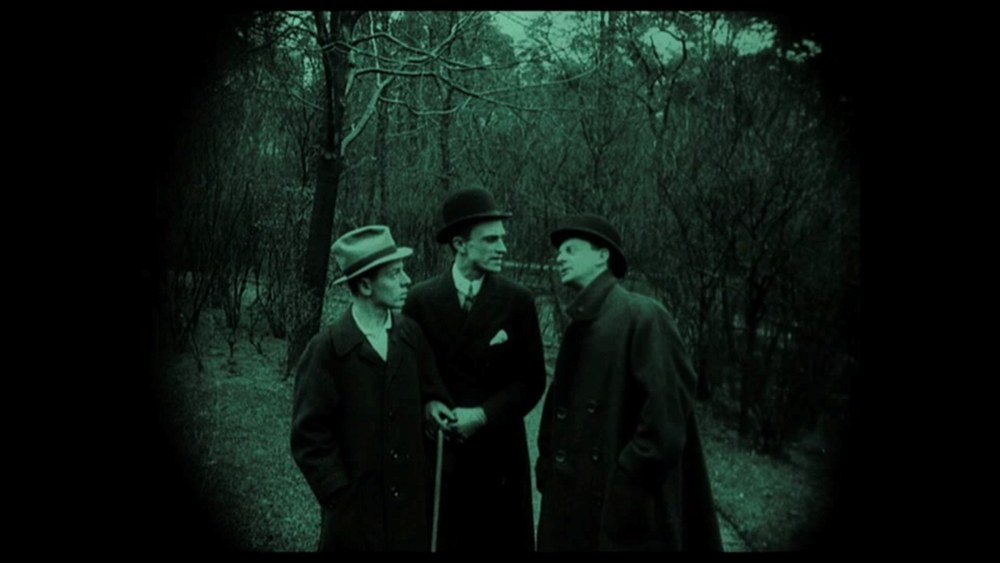
Another constant comes from a spatial history component. Anders als die Andern is a Kammerspiel, a chamber drama. The plot takes place mostly within Körner’s home, and one could surmise that this was a cost-cutting measure on the part of the enormously prolific Oswald. But there is one surviving scene outdoors, presumably in Berlin’s Tiergarten. The scene conveys the Tiergarten’s dual opposing charges: it is idyllic but also dangerous. Körner and his lover stroll arm-in-arm, pointing out the plants and trees to each other, before they are interrupted by Körner’s blackmailer. The couple came to the park to enjoy nature together; the blackmailer came to troll for victims.
Bolleck stalks Körner and his partner in Anders als die Andern
The Tiergarten is layered with queer history, most recently with the deadly 2026 attack on Christopher Street Day celebrations. Hirschfeld himself chose the Tiergarten as the location for his Institut. Its history as a gay cruising spot is well-known.20 The most visible sign of the Tiergarten’s queer history today is the 2008 Memorial to Homosexuals Persecuted under Nazism, designed by Michael Elmgreen and Ingar Dragset. A concrete block with a window displaying a looped film snippet of men kissing, the monument is not without controversy and has since broadened its representation to include film snippets of lesbians kissing. Yet historian Jennifer Evans, in her 2014 book chapter “Harmless kisses and infinite loops: Making space for queer place in twenty-first century Berlin,” attends to the controversies while arguing that the memorial performs a place making function for the city of Berlin and for its Tiergarten, drawing attention to this site to memorialize sexual minorities murdered and persecuted under the Nazis.21 The film scene contributes to the place making, and to this place’s ambivalent charge.
These ambivalent histories come forth in the dossier Ervin Malakaj and Shoshana Schwebel compiled for WeimarCinema.org. The selection of contemporary reviews shows just how controversial this film was in 1919, and in light of current politics, the positive reviews almost make for stranger reading. But this is not the only place the two film scholars show how Anders als die Andern provides opportunities for personal connection and reflection. Their sample one-week lesson plan leans into the Kammerspiel, the character study, the psychological drama. The sample assignment, a scene analysis, contains the directive “[o]n the basis of the points outlined in your description, interpret the scene with regard to the effect of sharing in Körner’s innermost thoughts.” This task gets straight to the heart of the 1919 filmmakers’ goals; it asks present-day university students to imagine kinship with a century-old fictional character. Would this work as well for any other silent film? Perhaps not. Perhaps it works with Anders als die Andern because for many today, its protagonist’s struggle is still a very personal one.
Conclusion
Is Anders als die Andern still relevant in the new ‘20s? Yes and no. It is dated, and it is also not dated enough. And in this respect, it is not alone. War, pestilence, and fascism have reappeared together and in full force. For those concerned with human rights and dignity, the last decade feels like re-fighting battles that had long been considered won. Rights for sexual minorities have eroded and continue to do so. Transphobia in particular has become a bizarre political sensation in the United States. Compassion and human connection across differences are at an all-time low. So revisiting Anders als die Andern might, in this context, be uniquely appropriate. But this time around, it is not the clarion call for reform that it was in 1919. It does not speak to the possibility of a better future. We know how that ended. In 2026, Anders als die Andern is somehow still ambitious. And it might be better taken as a warning.
Footnotes
1 Although Thea von Harbou did not specify a year, Metropolis’s reception has traditionally placed it one hundred years in the future. The first English translation of the book published in 1927 gave the year as 2026 AD. The 1984 Giorgio Moroder Metropolis similarly has an initial title card stating that the film takes place in 2026, however the Murnau Stiftung 2010 restoration does not give a year.
2 Austria’s neutrality during the Cold War facilitated exchanges between its film archives and those located in the Eastern Bloc.
3 See Ursula von Keitz, Im Schatten des Gesetzes. Schwangerschaftskonflikt und Reproduktion im deutschsprachigen Film 1918-1933, (Marburg: Schüren Verlag, 2005); Anja Laukötter, Politik im Kino: Eine Emotions- und Wissenschaftsgeschichte des Sexualaufklärungsfilms im 20. Jahrhundert, Humboldt-Universität zu Berlin, 2018.
4 The typed text of the letter reads: Sehr geehrter Herr Oswald: Nachdem ich heute der Erstvorführung des “Tagebuchs einer Verlorenen” im Uniontheater am Kurfürstendamm beigewohnt habe, bestätige ich Ihnen gern, dass ich durchaus den Eindruck einer von sittlichem Ernst getragenen Darstellung hatte. Eine sittliche Gefährdung erwachsender Personen ist meines Erachtens schon durch das vollendete Spiel der mitwirkenden Kuenster ausgeschlossen. Die löbliche Absicht zu zeigen, dass die Prostituierte nicht immer die allein Schuldige, sondern nur zu oft — ich möchte sagen in der Mehrzahl der Fälle — ein Opher gewissenloser und minderwertiger Maenner ( wie hier des Provisors u. des jungen Grafen) ist, tritt in eindringlicher Weise zutage u. Erinnert ergreifend an die einst über die Gefallene von Magdala gesprochenen Worte (” Wer unter Euch ohne Sünde ist, der werfe den ersten Stein auf sie”). Mit bestem Gruss gez. Dr. Hirschfeld. All translations mine unless otherwise stated.
5 If nothing else, through his testimony in the Eulenburg Affair, a series of libel trials taking place between 1907 and 1909 concerning the journalist Maximilian Harden’s suggesting of homosexual conduct between General Kuno von Moltke and Prince Phillip of Eulenburg.
6 Magnus Hirschfeld, ed., Jahrbuch für sexuelle Zwischenstufen XIX, Nr. 1 & 2 (October 1919): 6.
7 Andrea Surkus, “Betörend, diese Finesse! ‘Anders als die Andern’ - ein Schwulenfilm von 1919 kommt heute Aidskranken zugute” SZenario, May 31, 1999.
8 Vivian Sobchack, “What is Film History? or, the Riddle of the Sphinxes,” in Reinventing Film Theory, eds. Linda Williams and Christine Gledhill, (London: Oxford University Press, 2000).
9 Ervin Malakaj, Anders als die Andern, (Montreal: McGill-Queens University Press, 2023), 24-29.
10 The 2019 Anders als die Andern restoration was actually a side product of the Filmmuseum München’s 2019 Gesetze der Liebe restoration.
11 For more considerations of Hirschfeld’s legacy, see the forum on Laurie Marhoefer’s 2022 book Racism and the Making of Gay Rights entitled “After Weimar; Beyond Hirschfeld? Nostalgia, Hagiography and What Comes Next” in German History, Volume 43, Issue 2, June 2025, Pages 306–325.
12 Soleil Ho, “It’s Time To Kill the Hero” Coyote Media, March 18, 2026.
13 Heike Bauer, The Hirschfeld Archives: violence, death, and modern queer culture (Philadelphia: Temple University Press, 2017); Laurie Marhoefer, Racism and the Making of Gay Rights: A Sexologist, His Student, and the Empire of Queer Love (Toronto: University of Toronto Press, 2022).
14 J. Sundermeier, ‘Der Fuss auf dem Phallus’, taz (5 Apr. 2006), n.p.
15 Das Filmwerk „Anders als die Andern“ (§ 175) Eine Zusammenstellung. (Sonderabdruck aus dem „Jahrbuch für sexuelle Zwischenstufen“, Jahrg. XIX Heft 1 u. 2., 36.
16 Wolfgang Theis, Anders als die Andern, November 1st, 2019 – March 2nd, 2020, Schwules Museum, Berlin.
17 Das Filmwerk „Anders als die Andern“ (§ 175) Eine Zusammenstellung. (Sonderabdruck aus dem „Jahrbuch für sexuelle Zwischenstufen“, Jahrg. XIX Heft 1 u. 2., 38.
18 Wolfgang Theis, Anders als die Andern, November 1st, 2019 – March 2nd, 2020, Schwules Museum, Berlin.
19 Malakaj, Anders als die Andern, 104-109.
20 See Robert Beachy, Gay Berlin: Birthplace of a Modern Identity, (New York: Vintage Books, 2014).
21 Jennifer Evans, ““Harmless kisses and infinite loops: Making space for queer place in twenty-first century Berlin” in Queer Cities, Queer Cultures: Europe since 1945, Jennifer Evans and Matt Cook, eds., (London: Bloomsbury Publishing, 2014).
About the Author
Sara Friedman (sara.friedman@unco.edu) is Assistant Professor of Modern European History at the University of Northern Colorado. Friedman is working on a book manuscript entitled “Through Cinema to Justice: Anders als die Andern, the German Revolution, and Queer Film Culture in the Weimar Republic.” Publications include articles “Universal Language with a German Accent: Conrad Veidt in Silent Hollywood” (2021) in the German Studies Review, “Afterlives of Anders als die Andern and of Weimar” (2024) in Central European History, and a chapter “Virtual Witnessing: Weimar Cinema’s pre-Weimar Roots in Anders als die Andern [Different from the Others], 1919” in the edited volume Weimar’s Queer Visual Cultures (2026).